Networking is one of the most powerful tools for building your business. Whether you’re just starting out or have years of experience, connecting with the right people can open doors, spark ideas, and create opportunities you never imagined.
As the Queen of Connections, I’ve spent over 20 years helping businesswomen (and men, too!) grow their networks in meaningful, productive ways. Below are 10 straightforward, practical networking tips to help you stand out, make connections that count, and keep your business moving forward.
Always Be Prepared
Preparation is key. Before attending a networking event, think about what you want to achieve. Do you want to meet potential clients, collaborators, or mentors? Knowing your goal helps you stay focused and confident.
Bring business cards (yes, they’re still useful!) or be ready with a quick digital way for people to connect with you. Preparation shows professionalism and saves time for you and others.
Perfect Your Introduction
Your introduction is your chance to shine. Practice a short, engaging pitch that explains who you are, who you help, and how you add value. Keep it simple and memorable.
For example: “I help small businesses grow their visibility through strategic networking and connections.”
It’s not about sounding rehearsed — it’s about being clear and confident.
Focus on the Other Person
Networking is not about talking endlessly about yourself — it’s about building relationships. Ask questions, listen carefully, and show genuine interest in others.
People remember how you make them feel, so make sure your energy is warm, open, and curious.
It’s Not About What You Do — It’s About What You Offer
This one’s close to my heart. Too often, people get stuck describing their job title or tasks. Instead, focus on the benefit you bring.
Instead of saying: “I’m a financial adviser,” try: “I help women feel in control of their money and reduce stress around their finances.”
This small shift changes everything. People immediately understand how you can help them (or someone they know).
Follow Up Quickly
Meeting someone is only the first step — the magic happens in the follow-up. Send a short message within 24–48 hours to thank them, remind them where you met, and suggest a next step if it feels right.
For example: “Lovely to meet you at the 1230 TWC lunch. I’d love to hear more about your business — how about a coffee next week?”
Consistency builds trust, and trust builds business.
Be Visible and Consistent
Networking doesn’t work if you show up once and then disappear. Regularly attending events helps people recognise you, trust you, and think of you when opportunities arise.
Consistency is how you move from being a stranger to being part of someone’s trusted circle.
Share Your Expertise Generously
Don’t keep your knowledge locked away! Share tips, insights, and advice when you can. It shows your credibility and creates goodwill.
At an event, this might mean answering a question or offering a useful contact. Online, it might mean posting a blog (like this one!) or sharing valuable resources on LinkedIn.
The more you give, the more you’ll receive.
Mind Your Body Language
Networking isn’t only about what you say — it’s about how you show up. Smile, make eye contact, and keep an open posture. Avoid crossing your arms or looking at your phone.
Positive body language makes you more approachable and creates a stronger first impression.
Mix Online and Offline Networking
In today’s world, networking happens both face-to-face and online. Use platforms like LinkedIn, Facebook, and Instagram to stay visible between in-person events.
The trick is to be consistent. If someone meets you at an event, then sees your helpful post online, they’re more likely to remember and connect with you.
Enjoy the Process!
Networking should be fun, not stressful. Think of it as building friendships rather than chasing sales. The more relaxed and authentic you are, the more people will want to connect with you.
Approach it with curiosity and an open mind — you never know where one conversation might lead.
Wrapping It Up
Networking is not about quick wins. It’s about building long-term, trusted relationships that bring opportunities, collaboration, and growth. By preparing well, focusing on what you offer, and staying consistent, you’ll create connections that truly count.
So, next time you walk into a room full of strangers (or log on to a virtual event), remember these 10 Hot Networking Tips. Keep it practical, keep it authentic, and most importantly — enjoy the journey.
Because when you connect with the right people, you’re not just building a business — you’re building a community.
Over the past few years, mental health has moved from being something whispered about behind closed doors to a topic that’s front and centre in everyday conversations. And thank goodness for that. For too long, many of us carried silent struggles — stress, anxiety, burnout — thinking it was just part of life we had to “get on with.” But today, we’re starting to realise that mental health is just as important as physical health.
And here’s the thing: it doesn’t just affect how we feel, it impacts our relationships, careers, and yes — our finances too. Money and mental wellbeing are closely connected, often in ways we don’t even realise until we stop and think. So, let’s unpack how this greater awareness of mental health is shaping our day-to-day lives, particularly in relation to money.
The Link Between Mental Health and Money
I don’t think I’m exaggerating when I say money worries keep people up at night. In fact, financial stress is one of the most common triggers of anxiety and depression. Whether it’s rising bills, debt, or simply feeling like we’re not “keeping up,” money can take a toll on our mental wellbeing.
At the same time, poor mental health can make managing money even harder. For example:
Stress and anxiety can lead to avoidance — putting off looking at bank statements or bills because it feels overwhelming.
Depression can zap energy and motivation, making it harder to stay organised or make confident financial decisions.
Impulse spending can sometimes become a coping mechanism, giving us a temporary lift that quickly turns into regret.
So, the relationship between mental health and money is a two-way street. When one struggles, the other often does too.
The Shift in Awareness
The good news is that society is waking up. Workplaces, schools, communities — more and more people are recognising that mental health needs attention, care, and support. Even financial institutions are beginning to acknowledge the link. Banks and building societies, for instance, now talk openly about supporting customers with money worries, offering tools to help manage debt or spot risky spending patterns.
For individuals, this awareness means less stigma. We’re not (or shouldn’t be) ashamed to admit when we’re struggling. Talking about money and mental health together is becoming more normal — and that’s powerful. Because silence breeds shame, and shame keeps us stuck.
Everyday Life: The Subtle Impacts
So how does this awareness show up in our daily lives? Let’s bring it down to earth.
Conversations at home: Families are more likely to talk openly about financial stress or mental health challenges instead of bottling it up. This can bring relief and solutions.
At work: Employers are (slowly) realising that burned-out employees don’t perform well. Mental health support is moving up the agenda, and financial wellbeing programmes are part of that.
Social media: Love it or hate it, platforms are buzzing with content on budgeting, therapy, resilience, and mindfulness. It’s proof that people want to learn, share, and support each other.
Our choices: Being more aware of mental health makes us pause and think. Do I need this purchase, or am I buying it to feel better? Do I need to push myself through exhaustion, or is it time to take a break? Awareness is nudging us toward healthier decisions — in both money and life.
The Cost of Poor Mental Health
Here’s a reality check. Mental health struggles cost more than peace of mind — they have a very real financial price. Studies show that poor mental health can reduce productivity, increase sick days, and even impact career progression. For individuals, this might mean lost income, missed opportunities, or spiralling debt.
And in society? The costs are huge. Billions are lost each year in the UK due to stress, depression, and anxiety affecting the workforce. That’s why conversations about wellbeing aren’t just “nice-to-haves” anymore — they’re essential.
Building Financial Resilience Through Mental Awareness
One of the biggest positives of today’s greater awareness is that it helps us build resilience. When we understand the link between money and mental health, we can take steps to protect ourselves. Here are a few examples:
Budgeting with compassion: Instead of seeing budgeting as restrictive, we can frame it as self-care — a way of reducing stress by knowing where we stand.
Emergency funds: Awareness of mental health makes us realise the value of having a financial cushion. Knowing there’s a backup brings peace of mind.
Seeking support sooner: If stress over money feels overwhelming, more people are reaching out — to debt advice charities, financial advisors, or mental health professionals.
Talking about it: Simply sharing our struggles with a friend, family member, or support group can ease the load.
Why This Matters for Women
From my perspective, as someone who works with businesswomen and networks with them regularly, I can’t ignore that women often face unique challenges. The gender pay gap, career breaks, caring responsibilities — all of these can affect financial security. Add mental health pressures into the mix, and the challenges are magnified.
That’s why awareness is so vital. The more we talk about it, the more we can equip women (and men, too!) with tools, confidence, and support to handle both money and mental wellbeing.
Looking Ahead
The conversation is only just beginning. Greater awareness of mental health is already reshaping our daily lives, and over time, I believe it will transform how we view money. No longer as something separate from our wellbeing, but as an integral part of it.
Imagine a future where financial education goes hand in hand with resilience training. Where banks ask not just about your income, but also about your wellbeing. Where workplaces treat financial stress as seriously as they do physical safety. That’s the direction we’re heading, and awareness is the first step.
A Personal Takeaway
From a lay-person’s perspective — mine — I’d say this: awareness alone doesn’t solve everything, but it does change the game. It gives us language to describe what we’re feeling, it connects us with others who understand, and it pushes society to rethink old habits.
Money and mental health are like two sides of the same coin. When one is out of balance, the other feels it too. But with the conversations we’re now having, with the openness and resources becoming available, we’re better placed than ever to find balance, resilience, and yes — even a little peace of mind.
Final Thoughts
Mental health awareness isn’t just a trend; it’s a lifeline. And as we keep learning, talking, and connecting the dots, we’ll see real change — in our day-to-day lives, in our finances, and in the society we build for the future.
So next time you check your bank account or feel that pang of financial stress, remember: you’re not alone. Greater awareness is here, and it’s helping us all move forward — one honest conversation at a time.
The Colourful World of Emoji Hearts – and What They Say About Your Connections
Ever received a heart emoji in a message and wondered, “What does THAT colour mean?” Is it love? Friendship? A little sass?
As the Queen of Connections, I believe in communicating with clarity and style — so let’s dive into the emoji rainbow and see what these hearts really mean (and how you might use them in your networking, messages, or socials.
How to Use Hearts in Business (Without Overdoing It)
Emojis are powerful little connectors. They humanise our messages, soften our tone, and add personality — especially in the fast-paced online world.
Keep it on-brand
Use them to build tone and trust
Match the colour to the message
And when in doubt… you can always count on…
Queen’s Tip:
Connection is an art — and emojis are just another brushstroke. Use them wisely, warmly, and with intention… just like your networking.
Using the heart fits perfectly with 1230 TWC and brand:
It represents supportive, women-centred connections
It shows joyful networking and community warmth
And it keeps things professional with heart
Over to You
What’s your go-to heart emoji – and what does it say about you?
Drop it in the comments, send it in a message, or tag me in your next post — I’ll be there with one of mine!
Build Strong, Heart-Centred Connections That Fuel Your Business ?
Feeling like your networking strategy is more hold-on-a-second than hello!? You’re not alone. Many women describe networking as awkward, tense or shallow—but what if it was the opposite—fun, purposeful, and transformational?
we believe the right kind of relationship-first networking is the key to unlocking growth, influence and real business success. Here’s how to move from random contacts to purposeful relationships—all while being yourself.
Why “Relationship-First” Networking?
Connection meets commerce: When your network is built on shared values and trust, money follows more naturally.
Emotional resilience: Being part of a supportive circle lowers stress and increases confidence.
Credibility & clarity: You become easy to refer and difficult to forget when you’re genuine and visible.
Essential Elements of Relationship Networking
BeIntentional – Know Your Why
Define your goal (eg “I want five new collaborations in the next three months”). Align every interaction—online or face-to-face—around bringing value first.
Quality Over Quantity
Invest in a small circle of meaningful connections, , rather than chasing every card-swap opportunity.
NurtureConsistently
Networking isn’t one-off. Make a habit of a quick check-in, sharing helpful content or inviting someone to an event. Simple, consistent gestures build trust over time.
5 Doable Tips to Deepen Your Network
TipWhat It Does
Learn & Use Names Shows respect and helps build rapport
Show Up Authentically When people feel they’re talking to you, not a mask, bonds form
Follow Up A message after a meet-up can change a “nice to meet you” into a real connection
Offer Value First Introduce connections, share tips, or recommend a resource—no ask needed
Create Connection Rituals Invite someone to a small-group coffee, Zoom-catch up, or even Networking Bingo
Bonus: Women-Only Circles = Safe Launchpad
All-women groups (like 1230 TWC!) give you a confidential and courageous space to grow. You’ll find peers who get it—pressures, life stages, aspirations—and who will champion you along the way
entrepreneur.com.
Your Next Move
Reflect: Do you see networking as a chore or a conversation of meaning?
Commit: Choose one of today’s tips—name recall, genuine follow-up, or scheduled check-in—and do it this week.
Join us: Get a taste of connection-first networking at our next 1230 TWC event .
Join the conversation
How do you prefer to connect—one-to-one chats, group calls, Networking Bingo, or something else? Share your fav way to build real relationships.
Celebrating 60 Years of “Tainted Love” with Gloria Jones at Evolution of Finance for Businesswomen
It All Started With a Simple Idea…
At the height of Covid-19, when the world was shutting down, many people were suddenly cut off—not just physically, but digitally. Zoom was becoming a lifeline for connection, but for those unfamiliar, it felt more like a locked door than an open window.
As an IT trainer and champion of connection, I couldn’t just watch that happen. So, I launched Zoom for the Terrified—a warm, welcoming space for anyone feeling overwhelmed by technology. It wasn’t about buttons and menus; it was about belonging.
That decision led to one of the most surprising and powerful networking journeys of my life.
From Digital Support to a Motown Legend
Soon after those first Zoom sessions, I was contacted by Jenny Wilson, Chair of U3A Croydon—thanks to a wonderful introduction from the fabulous Valerie Apps, a former Host of our 1230 TWC Croydon group and long-time business coach.
Jenny was worried about the isolation many of her members—especially older women—were experiencing. I was delighted to help. What I didn’t expect was to meet so many inspiring women… or to find myself learning iPads on the fly (I’m a Windows girl, after all!).
That’s when Jenny introduced me to Brian Dunham—an extraordinary music producer who had worked with legends like David Bowie and Marc Bolan. Our friendship flourished, and we collaborated with Jed Dmochowski to create a Marc Bolan tribute film, filmed at 1230 TWC Host Kat Webb’s beautiful B&B in Birchington.
Although Brian sadly passed before seeing the final film, it was through him that I was introduced to someone unforgettable…
Gloria Jones: Legacy, Leadership & Love
Global icon. Soul powerhouse. Cultural changemaker.
Gloria Jones is so much more than the original voice behind “Tainted Love”—a track now celebrating 60 years since its first recording. She’s Motown royalty, a songwriter, producer, and fierce humanitarian. Her passion for giving back led her to establish the Marc Bolan School of Music and Film in Sierra Leone—empowering young talent through creativity and culture.
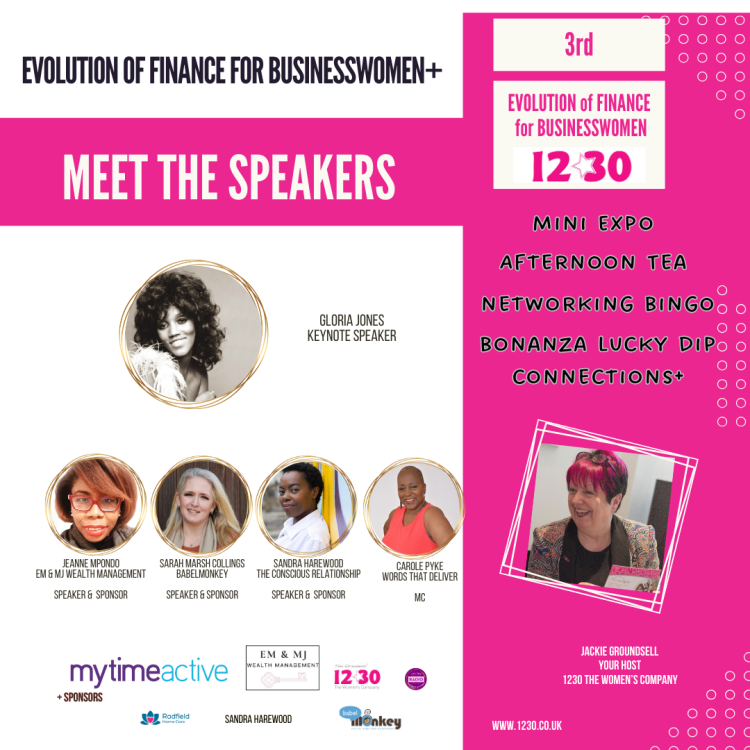
When I learned (through Jed) that Gloria would be in London this June, I reached out to invite her to join us for Evolution of Finance for Businesswomen. I was absolutely thrilled—and deeply honoured—when she said “yes” to being our Keynote Speaker.
Gloria will also be joining me on the 1230 TWC Business Beat Radio Show 19 May @LoveDaBeatRadio. Truly a full-circle moment of connection and inspiration.
So, Does Networking Work? You Tell Me.
From a pandemic-inspired Zoom class…
To a local Croydon connection…
To a legendary music producer…
To the Queen of Motown herself, Gloria Jones… To Beckenham, Thursday 12 June, where women in business will come together for insight, inspiration, and growth.
This is what real networking looks like: one connection leading to another, with a ripple effect that changes lives. It’s not about collecting contacts. It’s about building relationships that matter.
Join Us at Evolution of Finance for Businesswomen++
This one-of-a-kind event blends knowledge, empowerment, music, and celebration. Whether you’re navigating your financial journey or looking to expand your network with like-minded women, this is the place to be.
Expect:
Keynote from Gloria Jones
Expert speakers including Jeanne Mpondo, Sarah Marsh-Collings & Sandra Harewood
Afternoon Tea & Networking Bingo
Pink Champagne
Bonanza Lucky Dip Prizes
A vibrant, supportive atmosphere like no other
Thursday 12 June , Beckenham Secure your place now — don’t miss out on this incredible event!
Reclaiming Your Financial Independence in Business and Life
For far too long, women have been overlooked by traditional financial systems and underestimated in their ability to manage, grow, and protect wealth. But that’s changing. Today, more women are stepping into their own when it comes to building businesses, growing assets, and taking control of their futures. Still, there’s one factor that continues to complicate the journey—how relationships impact financial clarity and decision-making.
Whether it’s in love or business, the way money is handled within relationships can either support your goals—or quietly hold you back. So how do you stay in control of your financial direction? This article explores why keeping a firm handle on your finances is essential, and how to navigate relationship dynamics with confidence and clarity.
Why Financial Clarity Matters
Knowledge Isn’t Optional—It’s Foundational
Understanding how money works—how to earn it, grow it, manage it, and protect it—isn’t just about planning for retirement or affording luxuries. It’s about having the ability to make meaningful choices, protect yourself, and move forward on your own terms.
When women take initiative with their finances, they tend to:
Make stronger business decisions
Set clearer boundaries in relationships
Reduce stress and gain peace of mind
Create more room for personal and professional growth
Yet many women still feel hesitant or disconnected when it comes to financial topics. Complex language, outdated norms, or fear of making mistakes can be enough to keep anyone from taking the first step.
Tip: Start where you are. Whether it’s tracking spending, setting a savings goal, or reading up on investments, small actions build momentum. Financial confidence grows with use—just like any other skill.
Relationships & Financial Balance
Money is emotional—especially within relationships. While many partnerships are rooted in trust and shared goals, financial imbalance can quietly chip away at a woman’s independence.
Have you ever:
Avoided talking about money to avoid conflict
Handed over financial responsibilities even when it didn’t feel quite right
Felt unsure about your access to shared accounts or business assets
These aren’t just isolated experiences. They’re part of a larger issue that plays out in homes, businesses, and communities every day. Financial dependence—even when subtle—can lead to anxiety, lack of confidence, and fewer choices when life changes.
How to Stay in the Financial Driver’s Seat
Know Where You Stand
Understanding your income, expenses, assets, and liabilities gives you clarity—and that clarity brings confidence. Don’t rely on someone else’s word. Know your numbers and own your financial picture.
Set Clear Financial Boundaries
Boundaries aren’t barriers—they’re healthy expectations that keep communication honest. Some examples:
“Let’s both have visibility into our joint accounts.”
“I’d like to review our business finances monthly.”
“I’m getting outside advice to stay informed.”
Put Agreements in Writing
Whether in a marriage, partnership, or business—verbal understandings leave too much to chance. Put terms in writing: prenups, business agreements, wills, and profit-sharing arrangements. Clarity creates peace of mind.
Keep Learning
Financial literacy is a lifelong journey. From podcasts and workshops to mentors and online courses, resources are everywhere. Make learning about money a regular part of your routine—it pays off in more ways than one.
Let’s Talk About It
Financial independence isn’t a solo mission. It starts with conversation. Talk to friends, mentors, partners, or professionals. Ask questions. Share your experiences. Learn from one another.
You don’t need to be an expert to get started—you just need to be curious and committed.
here’s a lot of uncertainty in business at the moment—and that can lead to two seemingly opposite effects.
Some clients, especially larger businesses, are outsourcing more after layoffs or hiring freezes. For freelancers, this can be an opportunity to offer results-based services that are more cost-effective than in-house teams.
At the same time, smaller businesses are feeling the pinch and may cut back, particularly on retainers, even when notice periods are part of the agreement.
If your pipeline is light or you’re feeling unsure, now is the time to act—not wait. Here are some practical tips to help you steady your business and even grow amid all this change:
Practical Ways to Protect Your Retainers and Steady Your Freelance Business
Don’t ignore the silence. If an established client suddenly stops sending you enough work, start a conversation. It’s better to agree to reduce the retainer and keep the client than say nothing and risk losing them entirely.
Reframe the space. Freeing up those hours gives you the chance to bring in new work—possibly at a higher rate—or start something new. It’s scary, yes, but it could also open the door to growth.
Ask for referrals. Don’t just say “keep me in mind”—be specific. Try: “Do you know anyone who’s looking for this kind of support right now?” Timing is everything.
Ask for a testimonial. Or an updated one if you already have one. Make it easy for them—remind them of the results you’ve delivered and the best things you do for them.
Understand this is business, not personal. A change in the retainer isn’t a rejection of you. It’s a money conversation. Treat it as a negotiation, not a judgment.
Check your contracts (and do it early). If you’ve set up notice periods, remind yourself (and when the time is right, the client) of how much notice is required. Revisit your policy on carry-forward hours, and check whether your rates change if the client switches to a smaller package.
Check your pipeline. Got a waiting list? Now’s the time to reach out to the top names and invite them to start a trial. No waiting list? Revisit past discovery calls and proposals. It’s worth saying: “If you’d like to explore a package or option that fits your current budget, I’d be happy to help.” And remember—never do the same amount of work for less money. Always negotiate less for less, more for more.
Try not to panic. If this is your first turbulent trading period (we used to just call them recessions!), it can feel overwhelming. Review your subscriptions and overheads and cut back where you can.
And finally—a little KoffeeKlatch reassurance: We don’t take subscriptions from you, so there’s never a need to worry about how to cancel us. The only time you spend money with us is when you choose to go to the cart and purchase something. And if now is not the right time for you – that’s OK.
The landscape might be shifting, but your skills, your boundaries, and your value remain as solid as ever.
Stay visible. Stay in touch. Stay ready for new opportunities.
And remember—if you’re navigating any of these changes, you’re not alone.
Drop into the KoffeeKlatch customer support group for help aligning your next steps with your contracts and for a supportive space to talk it all through. We’re here to help
For far too long, women have been underserved by financial systems and underestimated in their ability to manage, grow, and protect their wealth. But that tide is turning. Today, a growing number of women are taking bold steps toward financial independence, business success, and personal empowerment. Yet one element continues to challenge progress—relationships and their impact on financial control.
From romantic partnerships to professional collaborations, financial dynamics within relationships can complicate even the most capable woman’s financial journey. So, how do you stay in the driver’s seat? This article explores why financial autonomy is non-negotiable—and how women can navigate relationship-based hurdles with confidence.
The Case for Financial Autonomy
Why Financial Knowledge Isn’t Just ‘Nice to Have’
Understanding how money works—how to earn it, save it, grow it, and protect it—is essential. Financial autonomy isn’t just about securing a better retirement or affording occasional luxuries. It’s about freedom of choice, personal security, and business resilience.
When women take charge of their finances, they:
Make better business decisions
Set stronger boundaries in relationships
Reduce stress and increase life satisfaction
Leave room for growth—personally and professionally
Yet according to recent studies, many women still defer financial decisions to others or feel intimidated by complex financial language and tools.
Solution: Start simple. Whether you’re tracking expenses, setting savings goals, or learning about investments, small actions compound over time. Financial power is a muscle—you build it through use.
The Hidden Impact of Relationships on Financial Freedom
When Love and Money Collide
Finances are often deeply emotional, especially within relationships. While many partnerships are built on trust and shared goals, it’s also true that financial imbalance can erode a woman’s independence, sometimes subtly.
Have you ever:
Avoided talking about finances to “keep the peace”?
Let a partner or business associate take the reins, even when it felt uncomfortable?
Been unsure of your financial rights or access within a shared account or enterprise?
These aren’t just personal problems. They’re systemic issues that play out in countless homes and boardrooms. Financial dependence—whether in a marriage or business collaboration—can lead to stress, reduced confidence, and fewer options if things go wrong.
Spot the Signs of Unbalanced Financial Power
Watch for these red flags that may indicate a power imbalance in your financial relationships:
One person controls all financial decisions
There’s secrecy or defensiveness around spending, saving, or earning
You’re discouraged from asking questions or educating yourself about money
You feel guilty or “selfish” for wanting financial independence
How to Regain (or Maintain) Financial Control
Know Your Numbers
Understanding your income, expenses, assets, and liabilities is step one. Whether you’re managing your household budget or overseeing a business, clarity is confidence. Don’t just rely on someone else’s word—own your data.
Set Financial Boundaries
Boundaries aren’t barriers—they’re guidelines for healthy communication and collaboration. For example:
“I’d like us both to have visibility into our joint finances.”
“In our business partnership, I’d like access to financial reports monthly.”
“I’m hiring a financial advisor for independent guidance.”
Get It in Writing
Verbal agreements are vulnerable. Written agreements protect both parties and reduce misunderstandings. From domestic agreements and wills to shareholder documents and profit splits—clarity protects connection.
Educate Yourself
There are more resources than ever to help women build financial fluency. Whether it’s a podcast, workshop, mentor, or online course, commit to lifelong learning in the language of money.
Mindset Matters: Reframing Your Relationship With Money
Many women were taught that money is stressful, unladylike, or someone else’s responsibility. It’s time to shift that narrative. Think of money as:
A toolto express your values
A resource to amplify your mission
A gift that multiplies when managed wisely
The better your relationship with money, the better your relationships with others—because you’re not operating from fear, scarcity, or dependency.
Empowering Each Other Through Financial Conversations
No woman should feel alone in her financial journey. That’s why open, honest, and even messy conversations are essential. Talking about money with peers, mentors, and professionals helps normalize it, demystify it, and defuse its emotional charge.
You don’t need to have it all figured out—you just need to begin.
In Summary: Financial Power Is Personal Power
Whether you’re navigating the early stages of your career, scaling a business, or planning for retirement, financial control is the key to living a life on your terms.
Remember:
Money doesn’t define your worth—but it supports your freedom
Relationships should never compromise your financial clarity
Your financial literacy is your legacy
The most empowered women are those who take charge of their financial journey—with eyes wide open and a support system by their side.
The time to step into financial leadership is now. Not someday.
Want more insight on empowering financial topics for businesswomen? Stay tuned for upcoming blogs, expert interviews, and community opportunities designed to help you take the wheel—confidently.
Artificial Intelligence is no longer a futuristic concept—it’s embedded in our daily routines. From voice assistants like Siri and Alexa to AI-powered email filters and chatbots, we interact with AI more often than we realize. But is this integration always beneficial?
The Benefits of AI in Daily Life
Efficiency: AI-powered tools save time and effort, whether through automated calendar scheduling or smart home devices adjusting lighting and temperature.
Improved Accessibility: AI-driven speech recognition and text-to-speech features help individuals with disabilities navigate the digital world.
Better Recommendations: Streaming services, online shopping, and even search engines use AI to provide personalized experiences.
Where AI Falls Short
Privacy Concerns: AI-powered systems often collect and analyze vast amounts of personal data, raising concerns about security and misuse.
Over-Reliance on Technology: Many people now rely on AI for navigation, decision-making, and even social interactions, potentially diminishing critical thinking skills.
Emotional Intelligence Gap: AI cannot fully replicate human emotions, leading to robotic customer service experiences and misunderstood nuances in conversations.
What’s Next?
AI will continue to evolve, and it’s up to individuals and businesses to adapt wisely. The goal should be to use AI as a tool, not as a crutch, ensuring that human creativity, ethics, and emotional intelligence remain at the forefront.
Artificial Intelligence (AI) is revolutionizing industries, transforming the way we work, communicate, and make decisions. While its potential is undeniable, the rapid rise of AI also brings concerns and challenges that individuals and businesses must navigate.
The Excitement: AI as an Opportunity
For many, AI is a game-changer, offering new levels of efficiency and innovation. Some key benefits include:
Automation of Repetitive Tasks: AI-driven tools handle mundane tasks, allowing professionals to focus on strategic thinking.
Enhanced Decision-Making: AI processes vast amounts of data quickly, providing insights that help businesses make informed choices.
Personalization & Customer Engagement: AI tailors recommendations and experiences, transforming how companies interact with customers.
The Concerns: Are We Relying Too Much on AI?
Despite its advantages, there are concerns surrounding AI’s rapid growth:
Job Security: Many professionals worry about automation replacing human jobs, leaving uncertainty about the future of employment.
Bias in AI Algorithms: AI learns from data, but if that data contains bias, the outcomes may be unfair or discriminatory.
Loss of Human Connection: With chatbots and automated responses on the rise, some fear that businesses are losing the personal touch.
Striking the Balance
The key to successful AI integration is balance—leveraging its strengths while maintaining human oversight. AI should be seen as a collaborator, not a replacement. Businesses and individuals who learn to adapt and work alongside AI will be better positioned for the future.
This website uses cookies to improve your experience. We'll assume you're ok with this, but you can opt-out if you wish.AcceptRead More
Privacy & Cookies Policy
Privacy Overview
This website uses cookies to improve your experience while you navigate through the website. Out of these, the cookies that are categorized as necessary are stored on your browser as they are essential for the working of basic functionalities of the website. We also use third-party cookies that help us analyze and understand how you use this website. These cookies will be stored in your browser only with your consent. You also have the option to opt-out of these cookies. But opting out of some of these cookies may affect your browsing experience.
Necessary cookies are absolutely essential for the website to function properly. This category only includes cookies that ensures basic functionalities and security features of the website. These cookies do not store any personal information.
Any cookies that may not be particularly necessary for the website to function and is used specifically to collect user personal data via analytics, ads, other embedded contents are termed as non-necessary cookies. It is mandatory to procure user consent prior to running these cookies on your website.



 Mind Your Body Language

 Building Financial Resilience Through Mental Awareness
 A Personal Takeaway

 Over to You
 Gloria Jones: Legacy, Leadership & Love