
1230 TWC - the most exciting place to be!
Category Archives for Guest Blogger

The Power of Connection: Customer Experience, Resilience, Music and Making a Lasting Impression

What can a retail expert and musician teach us about creating memorable experiences? And what can a career and mindset coach reveal about resilience, reinvention and navigating change? More than you might imagine!
Business Success Is About More Than What You Sell
Have you ever walked into a shop, restaurant or business and immediately felt welcome?
Perhaps someone greeted you with a genuine smile, remembered your name or took the time to understand what you actually needed.
You might not even remember everything you bought, but you’ll probably remember how that experience made you feel.
Now think about the opposite.
Have you ever walked into a business and felt completely invisible? Or perhaps you were made to feel that asking a question was an inconvenience?
Chances are, you remember that too!
The way we make people feel can have a lasting impact on our relationships, our reputations and ultimately our businesses.
It’s something I’ve believed throughout my years of bringing people together through 1230 The Women’s Company.
And it was a theme that emerged from two fascinating conversations on my 1230 TWC Business Beat Radio Show, featuring customer experience specialist Sam Bowden and career and mindset coach Bhavya Arora.
Although their professional backgrounds are very different, both offer valuable insights into how we connect with people, respond to challenges and create opportunities.
Let’s explore what business owners can learn from their experiences.
 Sam Bowden: Customer Experience Is Everyone’s Business
With more than 20 years of global retail experience, Sam Bowden has built his career around understanding what makes customer experiences memorable.
His professional journey has taken him from Sales Ambassador to senior retail leadership and training roles, giving him firsthand experience of what happens on the shop floor as well as behind the scenes.
Today, Sam works with retail teams and internationally recognised businesses, including HMV, Heal’s, concessions within Harrods, and Barker and Stonehouse.
He’s also a TEDx speaker, sharing ideas about communication, human connection and the importance of creating meaningful experiences.
Sam’s approach combines high professional standards with energy, enthusiasm and enjoyment.
And I particularly like that combination.
Because excellent customer service doesn’t have to be stiff, scripted or overly formal.
In fact, some of the most memorable experiences happen when people are encouraged to bring their personality into what they do.
Five Ways to Improve Your Customer Experience
You don’t need a huge budget or an expensive marketing campaign to make customers feel valued.
Often, the biggest improvements begin with small, thoughtful actions.
- Make the first impression count.
Whether someone walks through your door, visits your website, sends an email or joins an online meeting, their first experience matters.
A warm welcome, clear information and a helpful attitude can immediately establish confidence.
- Listen before offering a solution.
One of the most common mistakes in business is assuming we already know what someone needs.
Ask questions. Listen carefully. Be genuinely interested.
Sometimes the most useful thing you can do is allow someone the space to explain their situation.
- Make every interaction personal.
People want to feel recognised as individuals, not simply as another transaction.
Remembering a name, referring to a previous conversation or following up on something important can make an enormous difference.
- Pay attention to the little details.
Customer experience isn’t only about the big gestures.
It’s also about returning calls, keeping promises, providing clear instructions and making things easy for people.
Reliability builds trust.
- Give people a reason to remember you.
What happens after someone leaves your shop, completes a purchase or finishes a meeting?
A thoughtful follow-up, a helpful resource or a genuine thank-you can turn a one-off interaction into a lasting relationship.
And that’s where business opportunities often begin.
What Can Music Teach Us About Business?
There’s another interesting dimension to Sam’s expertise: his experience as a musician.
Music and business might initially appear to be very different worlds, but I think they have more in common than we sometimes realise.
Consider what makes a great musical performance.
It takes preparation, practice, technical ability, creativity and confidence.
But those qualities alone aren’t enough.
A musician also needs to understand the audience, communicate emotion, respond to what’s happening around them and work effectively with others.
Sound familiar?
Listening Is as Important as Performing
In music, listening is fundamental.
A musician who only concentrates on their own performance, without paying attention to the other musicians or the audience, can quickly lose the connection.
The same applies in business.
If we’re so focused on delivering our sales pitch that we forget to listen, we may miss the very information that could help us understand a potential customer.
Great communication is a two-way experience.
Whether you’re performing on stage, leading a team or meeting a new business contact, listening helps create understanding and connection.
Every Team Needs to Find Its Rhythm
Think about a group of musicians performing together.
Each person has a different role, but the performance succeeds when everyone understands how their contribution fits into the whole.
Businesses are no different.
Customer service, marketing, administration, leadership and sales all influence the overall customer experience.
If one part of the organisation isn’t working well, customers can feel the difference.
Creating a great experience requires teamwork, communication and a shared understanding of what the business wants to achieve.
Practice Builds Confidence
Musicians rarely deliver outstanding performances without preparation.
They rehearse, refine their skills, learn from mistakes and continue improving.
Yet in business, we sometimes expect people to deliver exceptional service without giving them the training or support they need.
Investing in people isn’t simply an operational expense.
It’s an investment in confidence, capability and customer relationships.
And when people feel confident and supported, they’re often better equipped to deliver an enjoyable experience for others.
The Art of Leaving a Lasting Impression
Sam’s customer experience expertise raises an important question:
What do people remember about you after the conversation has ended?
It’s something I talk about frequently in networking.
You can attend dozens of events, introduce yourself to hundreds of people and collect a mountain of business cards.
But what happens next?
Do people remember you?
Do they understand what you offer?
More importantly, do they feel comfortable enough to approach you again?
Being memorable isn’t necessarily about having the loudest voice or the most impressive presentation.
It’s about being authentic, showing genuine interest and creating a positive connection.
A great customer experience and a great networking conversation often begin in exactly the same way:
By making the other person feel that they matter.
Bhavya Arora: Resilience, Reinvention and Finding Your Own Direction
While Sam’s expertise focuses on the experiences we create for other people, Bhavya Arora’s work encourages us to look at something equally important.
The relationship we have with ourselves.
Bhavya’s journey has taken her from India to the UK, through professional experiences in finance and at Discovery Channel, and into a new chapter of personal and professional reinvention.
Choosing love, adapting to change and experiencing motherhood all played a part in reshaping her identity.
Today, as a career and mindset coach and author, Bhavya supports people seeking greater clarity, confidence and connection with themselves.
Her approach is rooted in resilience, authenticity and the courage to navigate change.
And those are qualities every entrepreneur needs.
Resilience Doesn’t Mean Being Invincible
We hear a great deal about resilience in business.
We’re told to be strong, keep going, bounce back and never give up.
But I sometimes wonder whether we make resilience sound more complicated than it needs to be.
After all, business owners are human!
We experience disappointment, uncertainty, frustration and occasional moments when everything seems to happen at once.
A difficult client, an unexpected expense, a cancelled project or a change in personal circumstances can affect even the most experienced entrepreneur.
Resilience doesn’t mean pretending that these challenges don’t matter.
It means developing ways to respond constructively, seek support when necessary and keep a sense of perspective.
 Bhavya offers a particularly useful reminder:
“Don’t personalise pressure — process it.”
I think that’s a phrase worth remembering.
Don’t Confuse a Setback with Your Self-Worth
Imagine you’ve spent weeks preparing a proposal for a potential client.
You’ve researched their needs, developed your ideas and invested considerable time in the opportunity.
Then you discover they have chosen someone else.
It’s disappointing, of course.
But does that mean you’re not good at what you do?
Absolutely not!
There could be dozens of reasons for their decision, many of which have nothing to do with your ability.
When we personalise every setback, it’s easy to become discouraged.
But when we look at the situation more objectively, we can ask more useful questions.
What can I learn?
Is there something I could improve?
What might I do differently next time?
And, perhaps most importantly, what’s my next step?
That’s where resilience becomes practical rather than simply motivational.
Five Practical Ways to Build Resilience in Business
- Recognise What You Can Control
You can’t control every decision, customer response or change in the market.
But you can influence how you prepare, communicate and respond.
Concentrating on those things helps prevent unnecessary frustration.
- Give Yourself Permission to Adapt
Changing direction isn’t automatically a sign of failure.
Sometimes a business model, service or strategy that worked brilliantly in the past needs to evolve.
Being adaptable can open doors you hadn’t previously considered.
- Build a Supportive Network
Running a business can occasionally feel lonely, particularly when you’re responsible for making every decision.
Having people around you who understand the challenges can make an enormous difference.
Sometimes you need practical advice.
Sometimes you need an introduction.
And sometimes you simply need someone to listen.
- Celebrate Progress, Not Just Results
It’s easy to become so focused on the next target that we forget to recognise how far we’ve already come.
Celebrate the successful meeting, the new connection, the difficult conversation you handled well or the small improvement you’ve made.
Progress deserves recognition.
- Make Space to Recharge
Bhavya’s appreciation of both adventurous experiences and quieter moments offers an important reminder.
Life doesn’t have to operate at full speed all the time.
Rest, reflection and time away from work can help us return with fresh perspective.
You don’t have to be constantly busy to be making progress.
Reinvention Is Part of the Entrepreneurial Journey
One of the things I find particularly interesting about Bhavya’s story is the idea of reinvention.
Very few business journeys follow a perfectly straight line.
We learn new skills, meet different people, discover unexpected opportunities and sometimes realise that our original plans no longer reflect what we want.
And that’s perfectly normal.
When I established 1230 The Women’s Company, I knew how important meaningful business connections could be.
Over the years, that belief has remained central to everything I do, even as the ways we connect, communicate and work have changed.
From face-to-face networking to online meetings, radio conversations, mentoring and writing, new opportunities have developed through listening, learning and responding to what people need.
The important thing isn’t to remain exactly where we started.
It’s to continue growing while staying true to the values that matter to us.
What Customer Experience and Resilience Have in Common
So, what connects Sam Bowden’s expertise in customer experience and music with Bhavya Arora’s work in mindset and resilience?
For me, the answer is human connection.
Sam’s work reminds us to understand the people we serve.
Bhavya’s work reminds us to understand ourselves.
Both require awareness, listening, empathy and the willingness to learn.
Both encourage us to move beyond automatic reactions and think more carefully about how we communicate.
And both can contribute to stronger businesses.
After all, if we’re constantly overwhelmed, it’s difficult to give our customers our best.
Equally, if we don’t understand our customers, even the most carefully developed business strategy may struggle to deliver the results we want.
Looking after your own mindset and looking after your customer relationships aren’t competing priorities. They support one another.
Networking: Where These Lessons Come Together
Of course, I couldn’t write about connection without talking about networking!
At 1230 The Women’s Company, we believe that networking should be supportive, enjoyable and genuinely useful.
It’s not about delivering a rehearsed sales pitch to everyone you meet.
It’s about conversations.
It’s about discovering what other people do, understanding their challenges, sharing experiences and recognising where opportunities for collaboration might exist.
And the lessons from Sam and Bhavya fit beautifully into this approach.
From Sam, we can learn to create a positive experience for everyone we meet.
From Bhavya, we can learn to approach networking with greater confidence, authenticity and resilience.
Not every conversation will lead to immediate business.
Not every introduction will become a customer.
And that’s absolutely fine!
Sometimes a conversation leads to a friendship, a recommendation, a fresh perspective or an opportunity that doesn’t emerge until much later.
That’s why consistency, curiosity and genuine interest matter.
Three Things to Try in Your Business This Week
If you’ve reached this point and you’re wondering how to turn these ideas into action, here are three simple suggestions.
First: Review one part of your customer journey.
Look at what happens when someone first contacts your business.
Is it welcoming, straightforward and helpful?
Identify one small improvement you could make.
Second: Reframe one challenge.
Think about something that’s been frustrating you recently.
Instead of treating it as a personal setback, ask what you can learn from it and what constructive action you can take.
Third: Have one conversation without trying to sell anything.
Contact someone in your network simply to find out how they are and what they’re working on.
Listen, be interested and see where the conversation leads.
You might be surprised by what develops.
Final Thoughts: Be Memorable, Be Resilient, Be Yourself
Sam Bowden and Bhavya Arora approach business and life from different perspectives, but their experiences offer a shared reminder.
Success isn’t only about technical expertise, qualifications or financial results.
It’s also about how we connect with people, how we respond when things become difficult and how willing we are to keep learning.
Music reminds us of the importance of rhythm, listening, preparation and teamwork.
Customer experience reminds us that people want to feel valued.
Resilience reminds us that challenges don’t have to define us.
And networking brings these lessons together through meaningful human relationships.
So, the next time you meet a potential customer, attend a networking event, face a business challenge or consider trying something new, remember:
Listen carefully. Make people feel valued. Don’t take every setback personally. And never underestimate the power of a genuine conversation.
Because you never know where that conversation might lead.
And that’s what 1230 The Women’s Company is all about.
Let’s Keep the Conversation Going!
If you’d like to discover more inspiring business conversations, practical advice and fascinating guest stories, listen to the 1230 TWC Business Beat Radio Show podcast:
Or, if you’d like to experience the power of meaningful networking for yourself, explore our online and in-person meetings:
Visit 1230 The Women’s Company
And if you’d like to connect with me personally, I’d love to hear from you.
Email: jgroundsell@1230.co.uk
Until next time, keep connecting, keep learning and keep supporting one another.
Jackie Groundsell
Founder, 1230 The Women’s Company
Radio Presenter, Author and The Queen of Connections

Jackie Groundsell
The Queen of Connections
1230 TWC

Giving the Next Generation a Voice: Why One Conversation Can Change a Life

Why Young People Need Real Experiences, Not Just Observation
One thing that struck me during the programme was how quickly the atmosphere changed once the students realised this wasn’t simply about sitting quietly in the corner and observing.
They became part of the conversation.
They were encouraged to ask questions.
They shared their own thoughts and aspirations.
They discovered that every experienced broadcaster, journalist and business owner once stood exactly where they are now—taking those first uncertain steps into the world of work.
Real work experience should never be about making tea or photocopying paperwork.
It should be about building confidence.
Giving young people permission to contribute.
Showing them that their opinions matter.
Helping them discover strengths they perhaps didn’t know they possessed.
Sometimes all it takes is one positive experience to change the way a young person sees themselves.
Confidence Doesn’t Arrive Overnight
Confidence is something I speak about regularly at 1230 The Women’s Company.
People often imagine confident people were simply born that way.
The truth is usually very different.
Confidence grows through experience.
It grows through conversations.
It grows by saying “yes” to opportunities that feel slightly outside your comfort zone.
Walking into a radio studio for the first time can feel intimidating.
Walking into a networking event can feel intimidating.
Giving a presentation can feel intimidating.
Starting a new job can feel intimidating.
Yet every confident person you meet has almost certainly experienced those same butterflies at some point.
The difference is that they chose to keep going.
Perhaps one day these five young people will look back on their afternoon in the radio studio as one of those defining moments when they realised they were capable of far more than they imagined.
The Importance of Listening
As someone who has spent more than two decades bringing people together through networking, I often say that the best communicators aren’t necessarily the best talkers.
They’re the best listeners.
During the programme, it was wonderful to watch the students listening carefully to one another as well as to the conversations taking place around them.
Listening isn’t passive.
It is an active skill.
It’s how we learn.
It’s how we understand different perspectives.
And it’s how meaningful relationships begin.
Whether you’re interviewing someone on the radio, attending a networking meeting or simply meeting somebody for coffee, listening is often the greatest gift you can give.
Why Local Businesses Matter
Work experience also reminds us of something else.
Communities thrive when local businesses work together.
Life In… Magazines gave these young people an opportunity.
The radio station welcomed them into the studio.
Other local businesses continue to support work placements, apprenticeships and mentoring opportunities throughout our borough.
Each organisation may only play a small part.
But collectively those parts create something much bigger.
They create opportunity.
And opportunity has a remarkable habit of multiplying.
One introduction becomes another.
One conversation leads to another.
One opportunity creates another.
That’s exactly how strong business communities are built.
Every Conversation Has the Potential to Change a Life
People sometimes ask why I enjoy networking so much.
The answer is actually very simple.
Because I never know which conversation is going to matter.
It may be the conversation that introduces someone to their future employer.
It may be the conversation that starts a new business partnership.
It may be the conversation that gives someone the confidence to launch a business.
Or perhaps it’s simply the conversation that reminds someone they’re capable of achieving more than they thought possible.
That’s why I still become excited every time I walk into a room full of people.
Because conversations change lives.
I’ve seen it happen time and time again.
Looking to the Future
I sincerely hope each of these young people continues following their ambitions, wherever those ambitions eventually lead.
Perhaps one will become a journalist.
Another may work in broadcasting.
One may pursue forensic science.
Someone else may discover an entirely different career they haven’t even considered yet.
Whatever happens, I hope they remember that somebody believed in them enough to say:
“Come and have a go.”
Those four words can sometimes alter the direction of a life.
My Final Thought
As I left the studio that afternoon, I found myself smiling.
Not simply because we’d recorded another enjoyable radio programme.
Not simply because the students had embraced the opportunity with enthusiasm.
But because I was reminded why I still love doing what I do after all these years.
Every week I have the privilege of meeting extraordinary people.
Some have decades of experience.
Some are only just beginning.
But every one of them has a story.
Every one of them has something to teach us.
And every one of them deserves the chance to be heard.
Perhaps that’s what the 1230 TWC Business Beat Radio Show has really become.
A place where conversations become confidence.
Where introductions become opportunities.
Where knowledge becomes inspiration.
And where one simple question continues to open doors…
“Tell me about you.”
Giving the Next Generation a Voice
You never know who you’ll meet, what you’ll learn, or where one conversation might lead.
Listen to and discover more from 1230 TWC Business Beat Radio
Jackie Groundsell
The Queen of Connections
1230 TWC

Why the Chatham House Rule Matters More Than Ever in Business Networking
Creating Conversations Built on Trust, Respect and Confidence

When people think about business networking, they often picture exchanging business cards, making introductions and building professional relationships. Whilst all of those things are important, the most valuable part of any networking meeting is often something much less obvious.
It’s trust.
At 1230 The Women’s Company (1230 TWC), we’ve always believed that the best business conversations happen when people feel comfortable enough to be themselves. For over two decades, we’ve created welcoming, supportive environments where businesswomen can share ideas, ask questions, celebrate successes and sometimes even admit that things aren’t going quite to plan.
One of the ways we encourage this openness is by observing the Chatham House Rule.
It may sound formal, but its purpose is actually very simple.
It helps create an atmosphere where honest conversations can flourish.
What is the Chatham House Rule?
The Chatham House Rule states that participants are free to use the information received during a meeting, but neither the identity nor the affiliation of the speaker, nor that of any other participant, may be revealed without their permission.
In simple terms:
You are welcome to share what you have learned.
You do not share who said it.
It isn’t about secrecy.
It isn’t about confidentiality agreements.
It’s about respect.
It allows people to speak openly, knowing that their experiences, ideas and questions won’t later be attributed to them without their consent.
 Why Does This Matter in Business?
Running a business isn’t always easy.
Behind every successful entrepreneur is someone making decisions, solving problems and sometimes facing uncertainty.
There are occasions when business owners want to ask questions such as:
- “Has anyone else experienced this?”
- “How would you deal with this client?”
- “Am I charging enough?”
- “Has anyone navigated this legislation before?”
- “I’m struggling with confidence—has anyone else felt like this?”
These are real conversations.
But they only happen when people feel safe enough to ask them.
If someone worries that their comments may be repeated outside the room, they are far more likely to remain silent.
Silence helps no one.
Trust helps everyone.
Networking is About Relationships, Not Transactions
One of the things I’ve learned over more than twenty years of bringing businesswomen together is that networking has never really been about selling.
It’s about relationships.
Business naturally follows when relationships are built on trust, mutual respect and genuine interest in one another.
The strongest professional relationships are rarely created because someone gave the best sales pitch.
They grow because people feel comfortable, understood and respected.
That’s why the atmosphere in a room matters just as much as the people in it.
A Safe Space Creates Better Conversations
Every 1230 TWC meeting is different because every woman brings her own experiences, expertise and perspective.
Sometimes conversations are light-hearted.
Sometimes they’re practical.
Occasionally, they’re deeply personal.
A business challenge may be linked to caring responsibilities, health, confidence, financial pressures or unexpected life events.
By observing the Chatham House Rule, we’re saying:
“This is a respectful place to learn from one another.”
People can ask questions they might never ask elsewhere.
They can share lessons learned without worrying that someone will repeat their story later over coffee or on social media.
The result?
More honest conversations.
More meaningful support.
Stronger business communities.
Learning Without Judgement
One of the greatest myths in business is that successful people always have the answers.
They don’t.
Successful people ask questions.
They seek advice.
They learn from others.
Some of the most valuable conversations I’ve witnessed over the years have started with someone saying:
“I’ve never told anyone this before…”
or
“I hope this doesn’t sound silly…”
Those conversations often become the turning point for someone else sitting quietly around the table thinking exactly the same thing.
That is the power of a trusted environment.
Respecting the Person Behind the Business
Every business has a human being behind it.
Sometimes we forget that.
Business owners experience the same challenges as everyone else.
Family responsibilities.
Health concerns.
Unexpected setbacks.
Moments of self-doubt.
Success is easier to celebrate—and challenges easier to overcome—when we know we’re surrounded by people who genuinely want to help rather than judge.
The Chatham House Rule supports that culture of kindness and respect.
Trust is Built One Conversation at a Time
Trust doesn’t appear overnight.
It grows gradually.
Every respectful conversation strengthens it.
Every promise kept reinforces it.
Every confidence honoured builds it further.
Eventually, something wonderful happens.
People stop worrying about saying the “right” thing and simply start having real conversations.
Those conversations lead to ideas.
Ideas lead to collaborations.
Collaborations lead to opportunities.
And opportunities change businesses.
Sometimes they even change lives.
The 1230 TWC Difference
At 1230 The Women’s Company, we don’t observe the Chatham House Rule because we have to.
We observe it because it reflects our values.
We believe businesswomen deserve spaces where they can learn openly, share honestly and support one another without fear of being quoted or misrepresented.
It creates a culture where conversations become richer, relationships become stronger and everyone benefits from the collective knowledge and experience in the room.
It’s one of the many reasons women return month after month.
Not just because of the networking.
But because of how they feel when they’re there.
Final Thoughts
In a world where information travels instantly and social media often encourages people to share everything, trust has become one of the most valuable assets any business community can offer.
The Chatham House Rule reminds us that whilst ideas are meant to be shared, people deserve respect.
It encourages openness without compromising privacy.
It creates confidence without creating barriers.
Most importantly, it helps build communities where people feel comfortable enough to have the conversations that really matter.
At 1230 TWC, we’ve always believed that the best opportunities begin with a conversation.
And the best conversations begin with trust.
Because you never know who you’ll meet, what you’ll learn, or where one trusted conversation might lead.

Jackie Groundsell
The Queen of Connections
1230 TWC

Your Database is Your Gold Dust – Don’t Let “Hello Jgroundsell Jgroundsell” Be Your First Impression

This morning, I received a spam email.
It began:
“Hello Jgroundsell Jgroundsell…”
Now, aside from the fact that it was clearly not written with care or intention, it highlighted something far more important — and something I see time and time again in business.
Poorly structured databases.
And here’s the truth…
Your database is not just a list of names.
It is one of the most valuable assets in your business.
First Impressions Happen in Seconds
Before someone reads your message, clicks your link, or considers working with you, they notice how you address them.
“Hello Jackie” feels warm, human and intentional.
“Hello Jgroundsell Jgroundsell” feels careless, automated and — quite frankly — unprofessional.
And in that moment, trust is either built… or lost.
Where It Goes Wrong
Most database issues don’t start with bad intention — they start with shortcuts.
- Names entered into one field instead of two
- First and last names combined
- Data copied and pasted without checking
- Systems not set up properly from the beginning
And then, over time, the problem compounds.
Emails go out.
Messages are automated.
And suddenly, your brand is communicating in a way that doesn’t reflect who you are.
Back to Basics: Structure Matters
If you take one thing from this, let it be this:
Your database must be structured correctly from day one.
At the very least, you should have:
- First Name
- Last Name
- Email Address
- (And where relevant) Company Name
Not:
- “Jackie Groundsell” in one field
- Or worse… duplicated entries like the one I received
Because once your data is messy, it becomes harder and harder to fix.
Excel is a Brilliant Starting Point
You do not need complicated systems to begin with.
A simple, well-structured Excel spreadsheet is more than enough.
But — and this is important — it must be set up correctly:
- Separate columns
- Consistent formatting
- No shortcuts
Think of it as laying the foundations of your business relationships.
Because that is exactly what it is.
From List to Relationship
This is where it connects beautifully with networking.
You already know (and I say this often!) that:
Networking is about relationships, not transactions.
Well… your database is where those relationships live.
Every name represents:
- A conversation
- A connection
- An opportunity
And how you store and use that information matters.
DPR – Not Optional
We also cannot talk about databases without mentioning GDPR.
Being GDPR compliant is not just a legal requirement — it is about respect.
- Do people know they are on your list?
- Have they given permission?
- Can they easily opt out?
When your database is clean, structured and compliant, you are building trust at every level.
Small Details, Big Impact
It is easy to overlook this.
It is easy to say, “I’ll tidy it later.”
But the truth is:
Small details create big impressions.
A correctly addressed email says:
“I see you.”
“I value you.”
“I care about this connection.”
And in business, that matters more than ever.

A Quick Checklist for You
Here’s a simple check you can do today:
- Do I have separate fields for first and last name?
- Are names correctly capitalised?
- Are there duplicates in my system?
- Am I confident my emails feel personal?
- Am I GDPR compliant?
If not — now is the perfect time to tidy things up.
Final Thought
That one email — “Hello Jgroundsell Jgroundsell” — will be forgotten.
But the lesson behind it shouldn’t be.
Because your database is not admin.
It is not background work.
It is the heartbeat of your business connections.
- Treat it with care.
- Structure it properly
- And let every message you send reflect the professionalism and warmth you stand for.
Jackie Groundsell
The Queen of Connections
1230 TWC

From a Swimming Pool Changing Room to a Growing Business: The Story Behind Go Goosey
Four Years In: When Reflection Matters as Much as Momentum
Go Goosey has been going for just over four years now, and if I’m being completely honest, this year feels like crunch time.
I’m someone who naturally looks forward. I’m always thinking about what’s next, what more I can do, and how I can make this business a long-term success. But I’ve learned that as a small business owner, it’s just as important to pause, look back, and remind yourself how far you’ve come, and why you started in the first place.
Because when things feel tough (and they often do), that “why” really matters.
The Parenting Moment That Sparked an Idea
The idea for Go Goosey didn’t come from a boardroom, a trend forecast, or a background in fashion or retail. It came from a very real, very emotional parenting moment.
I took my adopted daughter swimming for the first time. I was so excited, genuinely excited to introduce her to the joy of the water, just as my dad had done with me when I was little. It felt like one of those moments you picture in advance: splashing, laughter, confidence-building, a memory we’d both treasure.
And the swimming part was exactly that.
When a Lovely Day Turned Into Changing Room Chaos
But then we got out of the pool… and the changing room hell began.
She was cold and crying. I was cold. The changing rooms were cramped, damp, and chaotic. Clothes stuck to her wet skin. Towels slipped. I was trying to comfort her while also wrestling soggy fabric, all the while standing there freezing myself. What should have been the calm end to a lovely family trip turned into stress, tears, and frustration.
It completely spoiled the experience.
“Surely There Has to Be an Easier Way”
That night, lying in bed replaying it all, I remember thinking: Surely there has to be an easier way than this.
I’m not from a fashion or retail background. I’m absolutely useless with a needle, something that has since been proven many times over while attempting to sew my daughter’s Brownie badges. Starting a children’s clothing brand was not something I ever imagined doing. But I couldn’t shake the idea.
From Non-Fashion Background to Relentless Curiosity
What if there was something a child could put straight on after swimming?
Something warm, absorbent, quick-drying, and easy?
Something that removed at least part of that post-swim stress for parents and grandparents?
Six Years of Slow, Determined Progress
What followed wasn’t an overnight success story; it was six years of slow, determined work.
I researched fabrics obsessively. I spoke to suppliers. I tested materials. I asked a friend to help me make an early sample using a onesie pattern, just to see if the idea worked in real life. Eventually, I connected with a local fashion student who helped bring the concept properly to life.
The Birth of Go Goosey
In September 2021, Go Goosey was finally born.
What’s in a Name? The Inspiration Behind Go Goosey
Some people assume the name comes from goosebumps, that cold, shivery feeling after swimming. But actually, it’s inspired by the goose’s feathers, which are naturally water-repellent. Just like our fabric, they don’t just shed water – they dry incredibly quickly. Our onesies don’t just dry children; they dry on them.
Designing With Purpose, Not Trends
We launched with a single unisex colour. That decision was deliberate. I wanted something practical, something that could be passed down to siblings or shared with friends. I knew this wasn’t an everyday purchase; it was a luxury item, but it was also so much more than just a changing towel. It was about easing stress, saving time, and making outings more enjoyable.
The Highs: Recognition, Belief, and Unexpected Breakthroughs
Like most small businesses, the journey since then has been a mix of incredible highs and very real lows.
We’ve been nominated for two local business awards, moments that felt surreal and validating. We were given £6,000 by Simon Squibb, an international entrepreneur and social media influencer who asks people one simple question: “What’s your dream?” Our post reached over 10,000 likes and attracted hundreds of comments of encouragement and support from complete strangers who believed in what we were building.
When the BBC Came Calling
Another huge highlight was appearing on BBC Radio 4’s The Bottom Line with Evan Davis, talking about side hustles. I didn’t even mention our website, yet we sold 60 onesies in a single day and over 200 in total directly from that one airing. I received so many messages afterwards, particularly from grandparents, telling me how much they loved the idea and how useful it sounded.
Those moments are the ones I hold onto.
The Lows: Cash Flow, Doubt, and Juggling It All
But there have been lows, too. I still haven’t been able to pay myself from the business. Every day is a fight to get the product seen without a marketing budget. There are constant worries about loan repayments, cash flow, and whether I’m doing enough. I juggle Go Goosey alongside my main job as an IT recruitment consultant — the job that thankfully pays the bills and keeps everything afloat.
The Reality of Small Business Ownership
Running a small business is exhausting, exhilarating, and terrifying all at once.
Why Go Goosey Still Matters — and Why I’m Still Here
So, as I look ahead, knowing that this year really matters, I also want to acknowledge how far Go Goosey has come. What started as one cold, stressful moment in a swimming pool changing room has turned into a product that genuinely helps families. Every message, every review, every order reminds me that the struggle is worth it.
And that’s why I’m still here, working, pushing, believing — and why I’m so grateful to everyone who has supported Go Goosey along the way.
author – karen burke
Ghosts of the West End
Haunted Tales from London’s Theatreland!
The West End dazzles with neon lights, red carpets and thunderous applause. Each night, audiences flock to London’s Theatreland to lose themselves in music, drama and spectacle. But when the curtain falls, the crowds disappear and the stage lights dim, another world begins to stir!
Dare You Sit in One of London’s Many Haunted Theatres?
 At Stage Door Tours, we love stories that send a shiver down the spine just as much as we love sharing hilarious backstage mishaps and theatrical secrets. Join us as we step into the darker side of the West End — where history and hauntings entwine, and restless spirits still linger in the wings.
In the quiet hours after midnight, shadows creep across velvet curtains, footsteps echo in empty aisles, and whispers drift through darkened corridors. For centuries, London’s theatres have been places of intense emotion — triumph and heartbreak, fame and failure, life-changing moments played out beneath the spotlight. Perhaps it’s no wonder that some spirits have refused to leave the stage behind.
London’s theatres are among the oldest in the world, some rebuilt multiple times after fires, wars and renovations. Beneath their ornate façades lie layers of history — and, according to many performers and staff, layers of paranormal activity too. Ghostly sightings, unexplained sounds and eerie sensations are so common in Theatreland that many actors speak of them with a casual shrug… at least in daylight.
Once the house lights go down, however, bravery can quickly falter.
 The Theatre Royal, Drury Lane – The Man in Grey
No theatre on Earth is more famous for its ghosts than the Theatre Royal, Drury Lane. With a history stretching back to 1663, it has seen centuries of performances — and, some believe, centuries of hauntings.
Its most infamous resident is the Man in Grey, a silent apparition often glimpsed drifting through the upper circle. Dressed in an 18th-century cloak, tricorn hat and powdered wig, he is said to glide along the aisles before vanishing straight into the wall. Unlike many theatrical ghosts, he isn’t considered threatening. In fact, his appearance is regarded as a good omen — a sign that the show will be a resounding success.
The legend deepened during renovations in the 1800s, when builders reportedly uncovered a skeleton concealed within the theatre’s walls, clutching a dagger. Was this the Man in Grey, murdered and hidden away? Or merely a coincidence that fed the theatre’s already rich folklore? Whatever the truth, ushers, actors and audience members alike have sworn to see him — always watching, never speaking.
Drury Lane is also said to host other spirits: a distressed woman in white, phantom footsteps on the stage, and the sound of children laughing long after the doors have closed. For a theatre steeped in drama, it seems fitting that its ghosts are equally theatrical.
 His Majesty’s Theatre – The Phantom Before the Phantom
Long before Andrew Lloyd Webber’s Phantom of the Opera made the theatre world-famous, His Majesty’s Theatre already had a spectral reputation!
Stagehands working late at night report hearing mysterious music drifting from the empty orchestra pit — soft notes with no visible musician. Sudden icy drafts sweep across the stalls, even when doors are firmly shut, and lights have been known to flicker inexplicably during rehearsals.
Some performers whisper of an unseen presence watching from the shadows of the royal box, observing silently as if guarding the theatre. Is it a former actor unwilling to relinquish their favourite seat? Or a benevolent spirit ensuring performances go smoothly? The irony is not lost on cast members that a theatre now synonymous with a masked ghost may have harboured one long before the famous chandelier ever fell.
 The Palace Theatre – Shadows at Cambridge Circus
Standing proudly at Cambridge Circus, the Palace Theatre was originally built as a grand opera house — and many believe it still clings to its operatic past.
Staff have reported doors slamming shut with no one nearby, lights flickering on and off, and an overwhelming feeling of being watched in the upper levels. A brooding presence seems to linger backstage, particularly late at night when the building is quiet.
According to legend, the ghost may be a former manager, fiercely devoted to the theatre in its early days. Some say he remains bound to the building, ensuring the show goes on no matter what. Others claim he disapproves of the modern musicals that replaced the operas he loved — and makes his displeasure known through unexplained disturbances.
Whether protector or critic, the Palace Theatre’s shadowy resident certainly hasn’t taken his final bow.
Superstitions of the Stage
Where there are ghosts, there are superstitions — and theatre is famously full of them. Many traditions were born from genuine danger in centuries past, while others seem designed purely to appease whatever spirits might be lurking backstage.
One of the most enduring is the ghost light: a single lamp left glowing centre stage overnight. Practically, it prevents accidents in the dark. Superstitiously, it’s said to keep wandering spirits occupied — or at least stop them from causing mischief.
Whistling backstage is strictly forbidden. In the days of gas lighting and flying scenery, whistles were used as cues for scene changes. A careless tune could trigger a dangerous mishap — or, if legend is to be believed, summon something far worse.
And then there’s the Scottish play. Few performers dare speak the name “Macbeth” inside a theatre, for fear of invoking a curse that has plagued productions for centuries. Those who do must quickly spin around, swear loudly and ask permission to re-enter — just in case the spirits were listening.
Dare to Discover the West End’s Ghosts?
Behind every stage door lies more than stories of glamour and applause. There are whispers of tragedy, echoes of forgotten performances, and spirits who refuse to leave the place they loved most.
Theatres are living buildings — shaped by the passion, ambition and emotion poured into them night after night. Perhaps that energy never truly fades.
 Why not join Stage Door Tours and walk the haunted heart of London’s West End? Hear tales of actors who never left the stage, glimpse the shadows behind the curtain, and uncover the ghostly legends that give Theatreland its spine-tingling magic.
AUTHOR: ERICA HASLAM

Beyond the Spotlight: Professionalism in the Speaking World

Speaking opportunities are powerful. Whether it’s a keynote, a breakout session, a panel discussion or a community workshop, being invited to speak means being trusted — trusted with people’s time, attention, curiosity, and learning. It is a privilege that opens doors, builds reputations and connects speakers with audiences who may become clients, collaborators, champions or supporters for years to come.
And yet, organisers frequently ask the same quiet, private question:
“Do speakers truly value and maximise on the opportunities they’re given?”
It’s not a criticism. It’s not a judgement.
It’s a genuine reflection — born out of experience, observation, and the desire to create great events.
For many speakers, the answer is a heartfelt yes.
For others, it may be yes… but they don’t always show it.
And for some, it becomes yes… but only once they realise what was missed.
This blog is to help speakers — new and seasoned — understand what organisers look for, what audiences appreciate, and how valuing an opportunity enriches both the speaker and the event.
Because when speakers show they value the opportunity, the whole experience becomes stronger, smoother and more successful for everyone.
-
Valuing the Opportunity Starts Before the Event

When a speaker accepts an invitation, their relationship with the organiser begins immediately. And how they approach the lead-up says more about them than the talk itself.
Here’s what valuing the opportunity looks like before you take the stage:
Responding promptly
Timely replies to emails, messages and requests set the tone. Organisers juggle schedules, promotion and logistics — quick responses make their work infinitely easier.
Supplying materials when requested
Event pages, programmes and marketing rely on bios, headshots, talk titles and descriptions. Sending these promptly is an act of respect for the event and the audience.
Understanding the brief
Speakers who value the opportunity take the time to understand:
-
- What the organiser wants
- Who the audience is
- What outcome the session should create
- How their talk fits into the wider event
This shows care, professionalism and alignment.
Checking technical needs early
Clarifying slides, audio, room layout, timing and equipment well in advance avoids last-minute stress. It also reassures organisers that the speaker is prepared and invested.
- Valuing the Opportunity While On Stage
This is where speakers shine — or occasionally stumble.
Audiences and organisers notice far more than the content. They sense intention, presence, and genuine enthusiasm for being there.
Here’s what speakers who value the platform demonstrate:
Showing up on time and ready
Arriving early, not rushed, allows space for calm setup, tech checks and connection with the room.
Speaking to the time given
A professional speaker knows that going over time doesn’t make their message more powerful — it strains the programme, pushes others off-schedule and can frustrate the audience.
Keeping to time is one of the greatest signs of respect.
Being fully present
Valuing an opportunity means being:
-
- Engaged
- Attentive
- Enthusiastic
- Connected to the room
- Professional in tone and attitude
Audiences feel it instantly.
Tailoring the content
Great speakers don’t deliver a copy-and-paste talk. They adapt examples, stories and emphasis to the specific audience they are speaking to. This creates relevance and impact.
-
Valuing the Opportunity After the Event
This is where long-term relationships are built — and sadly where many speakers forget to follow through.
Here’s how truly professional speakers show appreciation after stepping off the stage:
A simple thank you
A short, heartfelt message of thanks to the organiser is powerful. They remember it. They feel valued. And they’re far more likely to book you again.
Sharing the event on social media
Posting before and/or after the event:
-
- Shows support
- Expands reach
- Reflects well on the speaker
- Helps the organiser in future promotions
It’s a small action with big impact.
Following up with attendees
This can be as simple as:
-
- Responding to messages
- Sharing a resource
- Reconnecting with people you met at the event
It strengthens relationships and demonstrates generosity.
-
Why Valuing the Opportunity Matters
When speakers truly appreciate the platform they’ve been given, several things happen:
Organisers notice — and remember
Professionalism stands out. It’s rare enough that when organisers see it consistently, they cherish it. That goodwill leads to:
-
- Repeat invitations
- Recommendations
- Increased visibility
- A glowing reputation behind the scenes
Audiences feel respected
They walk away with:
-
- A positive impression
- A sense that the speaker cared
- A memorable experience
And they talk about it.
The event flows better
When everyone is prepared, aligned and respectful of time, the organiser can breathe — and the event feels polished and seamless.
The speaker’s brand strengthens
Reliable, grounded, collaborative speakers rise above the noise. They become the ones people trust, book and speak highly of.
-
A Gentle Reminder for Speakers: Opportunities Are Collaborations, Not Entitlements
Every speaking slot — large or small — represents:
-
- Someone believing in your message
- An organiser putting their reputation behind you
- An audience giving you their time
- A chance to influence, support and inspire
None of this is guaranteed.
None of it is owed.
All of it matters.
And when a speaker shows they value the opportunity, they lift the entire experience.
-
A Final Thought
Most speakers genuinely do value the platform they’re given. Sometimes they simply need a reminder that their actions — not their intentions — signal their professionalism.

The truth is simple:
The speakers who appreciate opportunities are the speakers who keep getting them.
Most speakers do value the platform they’re given — deeply. Sometimes, however, in the rush of busy schedules, deadlines, business demands and travel, the actions that demonstrate appreciation get lost. It’s rarely intentional. It’s simply life moving quickly. But this is where the opportunity lies.
Because true professionalism isn’t just about delivering a great talk. It’s about the way a speaker prepares, the way they honour the organiser’s time, the energy they bring into the room, and the gratitude they show afterwards. These small, thoughtful gestures are often what organisers remember most — the signs that a speaker understands the privilege of being trusted with a stage.
Speakers who consistently show this level of care naturally rise to the top. They build stronger relationships, they receive more invitations, and they become known not only for their expertise, but for the integrity and respect they bring to every engagement. Their reputation grows quietly, steadily, meaningfully — the way the best reputations do.
So this is simply a gentle reminder, wrapped in encouragement: Valuing a speaking opportunity is one of the most powerful ways to elevate your impact.
When speakers show appreciation through their actions, they don’t just enhance the event — they strengthen their own voice, deepen their professional relationships, and create a ripple of goodwill that lasts long after the applause stops.
In the end, it’s simple:
The speakers who cherish the opportunity become the speakers people champion.
And that serves everyone — the speaker, the organiser, and the audience — in the most positive and inspiring way.


Helping your teenager with school anxiety – a guide for parents

What do you think of when you think about school? Do you remember loving or hating school? Or maybe a mixture of both? For too many teenagers and young people though, the answer to that question will be anxiety.
You may notice your teenager’s becoming more and more worried about going to school. Of course, it’s normal to worry sometimes, especially about exams or starting a new school. But, it can be a problem if your teenager finds school and the thought of going to school distressing. It may be a sign they’re experiencing school anxiety.
For some teenagers the anxiety is so intense they’re not able to go into school. If they do manage to get through the school day, anxiety impacts their learning. Often, friendships, confidence and health suffer too.
School anxiety and parents
School anxiety may often start to interfere with day to day life. It can put a huge strain on the whole family. And it can leave you as parents feeling exhausted and stressed.
Parents often end up feeling upset and guilty as they see their teenager struggling with school and becoming more and more unhappy.
It can affect parents and carers in other ways too, especially if they have to take time off work. This stress, in turn, can make teenagers feel more worried and guilty.

Anxiety about school is increasing
School anxiety in teenagers is on the rise in the UK. A study in 2024 by the youth mental health charity stem4 found almost three in 10 secondary pupils are avoiding going to school because of anxiety. Across the UK, 28% of 12 to 18-year-olds have not attended school over the last year for that reason. Many stayed away from school because they felt unable to cope.
School staff also reported a rise in student anxiety, with 72% of secondary school staff seeing a substantial increase in anxiety among students.
Teenagers feel anxious about school for many different reasons. It may be worrying about making friends or fitting in, or they may be being bullied. It could be they’re finding schoolwork or lessons confusing. They may feel under pressure to learn in a way that doesn’t suit them or struggle with relationships with teachers.
Teenagers with special educational needs are more likely to experience anxiety about school. They may have specific needs that aren’t being supported or struggle with the school environment.
Sometimes, anxiety around school may be because they’re going through difficult experiences outside of school, either at home or within the family.
Signs and symptoms of school anxiety

Teenagers may not open up about their thoughts and feelings, especially with their parents.
Instead, it can show up in their behaviour, such as
- anxiety, tears and anger about going to school
- trouble sleeping or getting to sleep
- not doing schoolwork, finding it hard to keep up and getting lower marks
- not going into school without telling you
- not wanting to get up and get ready for school
- saying they can’t go
- worrying a lot about small issues, such as having the right equipment for a lesson
- feeling sick, or having stomach aches or headaches before school
- being angry or upset, or acting out at home or school
- withdrawing from friends and activities
- appearing low or depressed
- struggling to concentrate.
Its very distressing for parents to see their teenagers so anxious about school. Anxiety about school isn’t new, but for a number of reasons, it’s on the increase.

Why is school anxiety rising?
Academic pressure and exams
The UK education system is very focused on exams and assessments. Students have regular testing. The system is shaped so that GCSEs and A-levels shaping young people’s futures. The pressure to achieve top grades is a major factor in stress and anxiety in teenagers.
Impact of the pandemic
COVID-19 disrupted routines, learning and social connections. Many teenagers have found going back into school difficult. The Children’s Commissioneriii reported a sharp rise in school absence and school refusal linked to anxiety since the pandemic.
Social media and peer pressure
Teenagers spend much of their social life online. They are constantly comparing themselves to edited versions of other peoples lives. Social media can create unrealistic expectations and intensify fears of being judged, excluded or bullied.
Bullying and friendship difficulties
Bullying can be devastating. It can turn happy teenagers into anxious, fearful and struggling ones. It can lead some teenagers to stop attending school altogether.
Even if they’re not being bullied themselves, they’ll still witness it happening to others. This increases the pressure to fit in socially. It ramps up their fear of being embarrassed or rejected. As a result, it can make school feel overwhelming and unsafe for many teenagers.

Wider uncertainty and stress
Teenagers are growing up in a world of change and uncertainty. They’re absorbing 24/7 newsfeeds full of information and concerns about climate change, economic instability and conflict. They may also have family stress. These all feed into a background of uncertainty, which can ramp up school worries.
Better awareness of mental health
Society in general is more open about mental health. Many young people now recognise and can name anxiety. Their parents too are also aware of the impact of anxiety. This is generally positive as families are more likely to seek help. As more people seek support it highlights issues that may have remained hidden.
Client story
Millie’s problem
My client Millie (not her real name) is a 16 year old who was struggling with anxiety around school. She had always found school stressful. She spent some time in hospital and at home recovering. When she was able to return to school again, she just couldn’t cope. By the time Millie came to see me she hadn’t been school for a whole day for several months. She had lost contact with her friends and worried a lot about social situations.
Millie had lost belief in her ability to make and keep friends. She was becoming increasingly anxious and couldn’t bear the thought of going into school. Millie was withdrawn and isolated from her peers and had lost all confidence in herself.
She felt critical about herself and compared herself to others negatively.
Millie’s results
Millie loves art and photography. We included her love of being creative into the therapy as we worked together. Millie wanted to be able to go to school, feel comfortable, stay and attend lessons. She also wanted to feel better about talking to others and to be able to make a friend.
We worked together to help Millie manage her anxiety and panic in social situations. She learnt how to cope with her anxious feelings. When she started to feel overwhelmed, she was able to use the coping skills we had worked on together. In this way, Millie learnt she could cope and take action to help herself.
I supported Millie to conduct mini experiments. With each small step she took, she started to feel more confident. We practised what she could do in social situations. As a result, she became brave enough to speak to a girl she liked at school. They became friends and began to meet outside of school. As her confidence grew, Millie was able to spend more time at school.
In Millie’s mum’s words
Celia connected with and understood my daughter so well. Celia was so warm, welcoming and friendly that it immediately put my daughter at ease. She actually looked forward to her sessions. Celia has been so supportive. I’m so happy to see my daughter learn new ways to cope with her worries, regain her self confidence and move forward. Her confidence in being able to overcome what was making her anxious has grown so much. I am so amazed to see how far my daughter has come. She’s going to school and has friends and life at home is so much easier now. Thank you so much Celia

How to help your anxious teenager
If your teenager is struggling at school right now, it can be overwhelming You may feel constantly stressed and exhausted by it, all. And ever more so if you’re juggling it alongside work and other family commitments. For parents, it can bring up worries about the impact on their teenagers education or future. Many also worry how it affects them socially as well. Things are probably feeling hard for your teenager too.
It’s distressing to see your teenager struggle with school anxiety. Here are some ways you can support them.
1. Give them space to talk
Teenagers often find it hard to talk about how they feel. You can help them to open up. It can help to allow your teenager time and space to talk where you simply listen to them.
As a parent, it’s tempting to try and come up with solutions. But teenagers need to feel understood. Even more so when they’re having a difficult time. Even though it can be hard, it’s more helpful if you can listen, acknowledge and validate their feelings. Statements you could use are
- “I can see this feels really hard right now.”
- “Tell me what feels most worrying about tomorrow.”
- “Is there anything I can do to help?”
Being listened to helps teenagers feel understood and accepted. This helps them to feel less isolated and ashamed about their feelings.
2. Let home be their calm place
Routine creates security. Regular sleep, balanced meals and predictable mornings all help regulate stress. Feeling calm when they’re at home can give teenagers a break from the anxiety they experience at school.
Mornings in a busy household with several children can be busy. It can help teenagers who are struggling with anxiety if school mornings are as calm as possible. This means trying to avoid last-minute rushing, shouting or arguments around going to school. All of these can end up making your teenager feel more anxious around school.
3. Break challenges into small steps
The thought of a full day at school may feel like too much for your teenager. You could work with them to break it down, for instance.
- Start by aiming for tutor group only.
- Progress to mornings before lunch.
- Build up to full days.
Breaking situations into small steps can stop them from feeling so overwhelming for your teenager.
You can work with your teenager to start with the areas they find less challenging. For instance, some teenagers find the unstructured time the most difficult so it would unhelpful to start with this. Instead, they may want to start with the lessons or school routine they find easier. Gradually exposing your teenager to situations they find challenging and for them to experience being able to cope, helps your teenager to understand they can manage their anxiety.
This approach helps them to gently face their fears and build resilience.


4. Teach coping skills
You can help your teenager to develop a toolkit to help them to manage their anxious feelings, such as
- Hypnosis (Find out more here)
- Breathing techniques (Find out more here.)
- Grounding exercises (Find out more here.)
- Exercise – walking, running or sport to release tension. (Find out more here.)
- Bedtime wind-down routines – journalling, reading, listening to calming music. (Find out more here.)
With practice, your teenager will be able to call on their toolkit when they notice the first signs of anxiety.
5. Work with the school
UK schools are expected to support students with mental health needs. Speak to your teenager’s form tutor, head of year or pastoral lead. Reasonable adjustments could include:
- A safe space to retreat to if anxiety spikes.
- Access to a trusted adult in school.
- Flexible deadlines or phased return after absences.
- School counselling or mentoring support.
Do you need more support for your teenager?
If your teenager is struggling with school anxiety, you don’t have to face it alone. Many parents feel worried, frustrated or unsure about the best way to help – and that’s completely understandable.
As a psychotherapist and cognitive behavioural hypnotherapist, I specialise in supporting young people and families who are dealing with anxiety. Together, we can:
- Understand what’s driving your teenagers anxiety.
- Teach them practical coping strategies they can use in everyday life.
- Help rebuild their confidence so school feels more manageable.
- Support you as a parent to feel clearer and more confident in how you respond.
You don’t have to wait until things feel unmanageable. Reaching out early can make a real difference.
Author: Celia Griver
HDip CBH Dip Hyp CS GQHP BA (Hons)
In-person | Online | One-to-one | Workshops

Testimonials: Your Secret Sales Team (That Never Sleeps)

Why Social Proof Isn’t “Nice to Have” — It’s a Growth Engine
Let’s be honest: we’d all love our marketing to work so well that new clients simply appear, pre-warmed, pre-sold, and happily asking, “Where do I sign?” While you perfect that cloning machine, there’s a far simpler, proven route to trust: testimonials.
Testimonials are the social proof that turns curiosity into confidence. They reassure nervous buyers, nudge fence-sitters, and neutralise objections—often better than any feature list. When done well, they become a compound-growth asset you can use everywhere.
The Psychology: Why Testimonials Convert
- Trust transfer: People are wired to follow the experiences of others. When a peer sings your praises, the buyer’s brain relaxes.
- Risk reduction: A good testimonial says, “I took the leap and it worked.” That reduces perceived risk far more than a polished pitch ever can.
- Specific > generic: A line like, “They were great!” is lovely… and useless. Specific outcomes (time saved, revenue gained, anxiety reduced) influence decisions.
Pro tip: Metrics make the magic—“We cut onboarding time from 2 hours to 20 minutes” beats “We saved time.”
The Testimonial Flywheel
Collecting testimonials isn’t a random act of delighted clients. Think in terms of a system—a flywheel that gathers momentum:
- Collect
Ask quickly—within 24–72 hours of a win. Use 2–3 smart prompts to get specifics. - Curate
Edit for clarity (with permission). Prioritise quotes that include a result and who the client is. - Publish
Website, proposals, landing pages, social posts, email signatures, and printed materials. - Repurpose
Turn quotes into caselets, carousels, reels, speaker slides, and objection-busters.
Keep the flywheel spinning and you’ll always have fresh proof at hand.
What Makes a “High-Conversion” Testimonial?
- Context: Who is the client (role/industry) and what was their challenge?
- Moment of change: What shifted during or after working with you?
- Outcome: What improved—time, revenue, peace of mind, clarity?
- Texture: A line of personality or emotion. Buyers are human; let it show.
Weak: “Great service. Would recommend.”
Strong: “Within 30 days, we had a clear sales process and two new partners. The weekly check-ins kept us moving when we would normally stall.”
7 Places to Put Testimonials (That Aren’t Just Your Website)
- Proposal decks — a short quote on the cover or near your pricing.
- Service pages — next to each offer; match the testimonial to the service.
- Email signatures — a one-liner with a link to the case study.
- Social proof strip — homepage carousel with logos + short quotes.
- Checkout/booking pages — reduce last-minute jitters.
- Event pages — from attendees and sponsors; lift registrations.
- Slides & webinars — testify while you teach.
“Ask Smarter” Prompts (That Get Better Answers)
Instead of “Could you write me a testimonial?” try:
- What was happening before you worked with us (and what did you want to change)?
- What felt different within the first 1–2 weeks?
- What result are you most pleased with (numbers welcome!)?
- If a friend asked whether to work with us, what would you tell them?
Permission to lightly edit for clarity is key—add it to your form so you can tidy typos without changing intent.
A Dash of Humour (Because Boring Doesn’t Convert)
Testimonials don’t need to read like legal affidavits. Let your client’s voice shine:
“We went from ‘hope is our strategy’ to actually having one. Now my diary’s full of right-fit meetings and I sleep like a cat in a sunbeam.”
Humour makes your brand memorable. Just keep it authentic and on-tone.
Common Myths (Gently Debunked)
- “We’ll ask later.” Translation: never. Ask when the win is fresh.
- “We don’t have results yet.” Capture the experience and early wins. You can add bigger outcomes later.
- “It feels awkward.” Frame it as feedback to help others make a confident choice. Most happy clients say yes.
A Simple 20-Minute Weekly Routine
- Minute 1–3: List two wins you helped create this week.
- Minute 4–8: Send two testimonial requests with the prompts above.
- Minute 9–12: Curate one existing quote for a specific page/post.
- Minute 13–20: Publish one proof point (website, social, proposal).
Consistency beats a once-a-year scramble.
Turning Quotes into Conversions: Micro-Caselets
Upgrade standout testimonials into 150–250 word “caselets” with:
- The client and context
- The problem
- What you did (in plain English)
- The outcome (quantified if possible)
- A succinct client quote
These outperform long, dusty case studies that no one finishes.
A Note on Ethics (and Legal Bits)
Always get permission to publish names, photos, and logos. If a client needs anonymity, use role + sector (“Operations Director, Healthcare”).
Keep a dated record of consent. And never invent or over-polish—trust, once broken, is hard to rebuild.
Final Word: Let Your Clients Brag for You
Testimonials are your always-on sales team—working across your site, proposals, and socials. They carry your credibility further than any “About” page, and they do it in a voice buyers recognise as their own.
 Build the flywheel, ask smarter, and let your best work speak for itself.
In short, testimonials are the easiest way to borrow your future customer’s brain and let it talk them into working with you. They shrink risk, boost trust, and do the heavy lifting long after you’ve closed your laptop. Build the flywheel: ask quickly, make it easy, capture specifics, and publish everywhere that matters—website, proposals, socials, event pages. Add a sprinkle of personality (and the odd cat-in-a-sunbeam line if it fits), but keep outcomes front and centre. Do this consistently for a month and you’ll notice warmer enquiries, smoother sales conversations, and fewer “just checking” emails. Do it for a quarter and you’ll wonder how you ever marketed without it. Ready to let your clients brag for you? Set up the form, send two requests today, and give your best work the spotlight it deserves.

The True Value of an Event: It’s Not the Ticket Price — It’s What You Do With the Time Introduction: Stop Pricing the Priceless

People often judge an event by its entry fee. If it’s “expensive,” they expect big results; if it’s “cheap,” they expect less. But the real value of an event isn’t the ticket price — it’s the outcomes you create before, during, and after you show up. In other words, value isn’t purchased; it’s produced. This blog unpacks how to recognise, unlock, and measure that value so every event becomes a strategic growth moment, not just a date in your diary.
Think in Outcomes, Not Admission
A ticket buys you access; your intention and actions create outcomes. Shift your lens from “What did it cost?” to “What did it change?” Ask:
- What new clients, collaborators, or advocates did I meet?
- What ideas did I capture and implement?
- What visibility did I gain with my ideal audience?
- What skills, confidence, or clarity did I strengthen?
When you evaluate outcomes rather than price, you stop underestimating low-cost events and stop overvaluing high-cost ones. You value the match between the event and your goals — and your performance on the day.
The Event Value Stack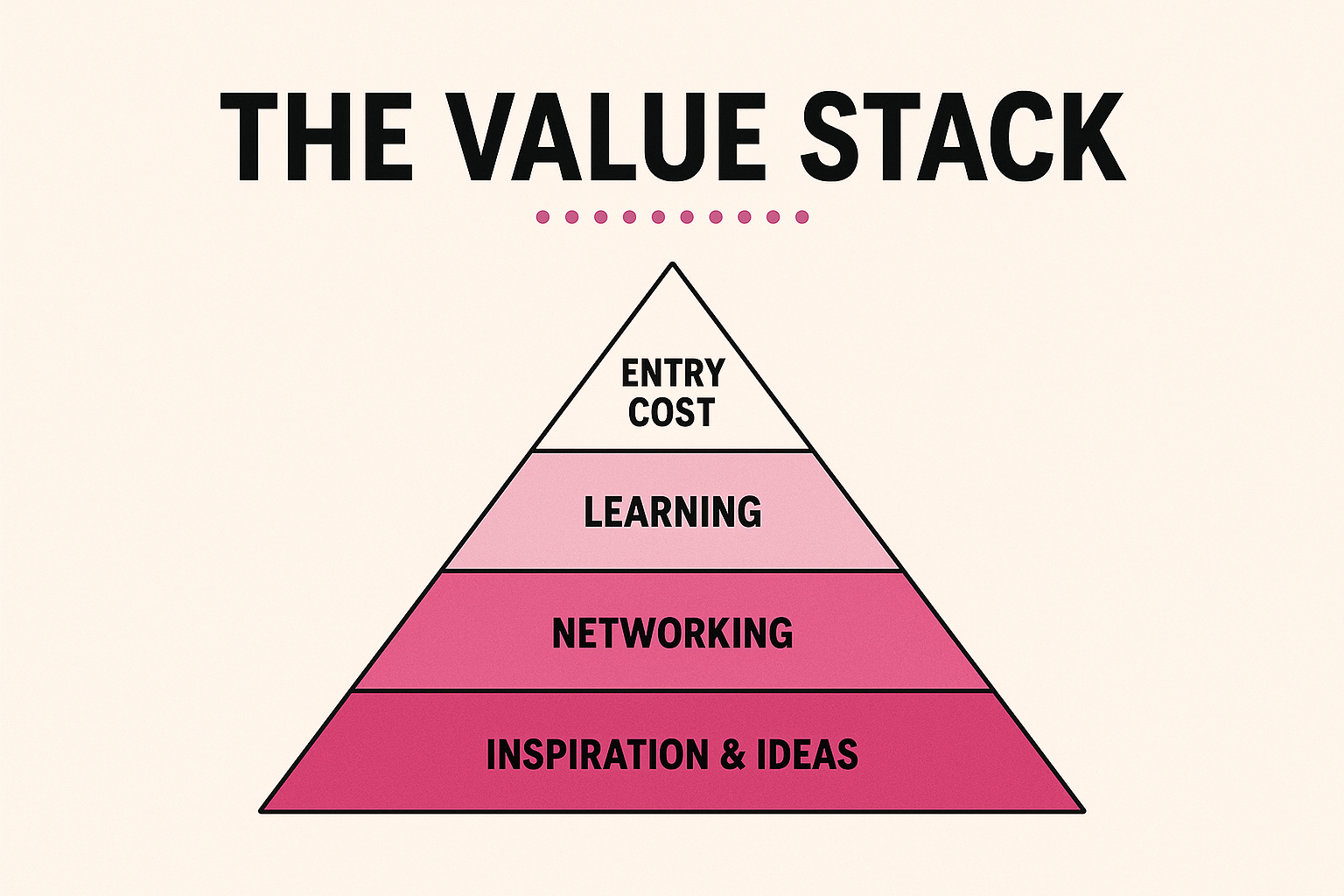
Use this layered view to identify where value lives:
- Learning Value
- New ideas, frameworks, and case studies
- Tools, templates, and practical shortcuts
- Confidence to try something new
- Connection Value
- Warm introductions to decision-makers
- Peer support and accountability
- Access to communities you can serve
- Visibility Value
- Being seen by your niche
- Speaking, panel, or Q&A moments
- Social content and PR hooks
- Commercial Value
- Qualified leads and booked calls
- Partnerships, referrals, and collaborations
- Deals closed and future pipeline
- Momentum Value
- Renewed motivation and focus
- Clarity about next steps
- Energy to execute faster
Each layer compounds. A single face-to-face conversation can spark content ideas, lead to an introduction, and then become a client. That chain of value rarely shows up on a receipt — but it can transform your quarter.
Before the Event: Prime the Outcomes
Most people walk in cold and hope for serendipity. Top performers prime it.
Set one primary objective and two secondary goals
- Examples: “Book 3 qualified follow-up calls” (primary). “Meet 1 potential partner and 1 media contact” (secondary).
- Research the room
- Scan the speaker list, attendee tags, or sponsor roster
- Identify 5–10 people you’d like to meet
- Prepare a short “why we should connect” openeCraft your “value hook.”
- One sentence: who you help, the problem you solve, the outcome you deliver
- One proof point: a result or testimonial
Prepare assets
-
- A clear call-to-action (CTA) you can mention in conversation
- A lead magnet or resource you can share instantly
- A simple way to book a follow-up (QR code, calendaring link, or card)
Pre-engage
Comment on speakers’ posts
- Message 2–3 target attendees to say you’re looking forward to meeting
- Ask organisers whether you can contribute (questions, roundtables, recap)
During the Event: Be Present, Be Useful, Be Memorable
Events favour the proactive. Focus on contribution first, conversion second.
- Open strong
- Sit near the front, ask good questions, and share a relevant insight
- Offer to connect two people with a shared need
- Practise “curated curiosity.”
- Ask: “What’s your priority this quarter?” “What would make this event a win for you?”
- Listen for problems you can solve or signpost
- Capture context, not just contacts.
- Note who introduced you, topic discussed, promised next step
- Tag your notes by theme (partnership, client, media, supplier)
- Build micro-visibility.
- Share one thoughtful post per break: a takeaway, a speaker quote, a shout-out
- Tag the organiser, speakers, and new contacts
- Protect your energy.
- Schedule short breaks to reflect and prioritise
- Quality beats quantity — five rich conversations trump fifty shallow ones
After the Event: Turn Momentum into Measurable ROI
Most value is won after the room empties.
Follow up within 48 hours
- Reference the conversation context
- Share the promised resource
- Suggest a specific next step and offer two time options
- Create and distribute content.
- Write a recap with three takeaways and one action
- Turn notes into micro-posts for the next two weeks
- Record a short video summarising what you learned
- Systemise the lead flow.
- Add contacts to your CRM with tags and next actions
- Create a “post-event cadence”: Day 2 follow-up, Day 7 resource, Day 21 check-in
- Track outcomes, not effort.
- Meetings booked, proposals sent, deals closed
- Partnerships initiated, podcasts booked, speaking invites
- Website visits and email sign-ups from event content
A Simple Framework: The 3–3–3 Rule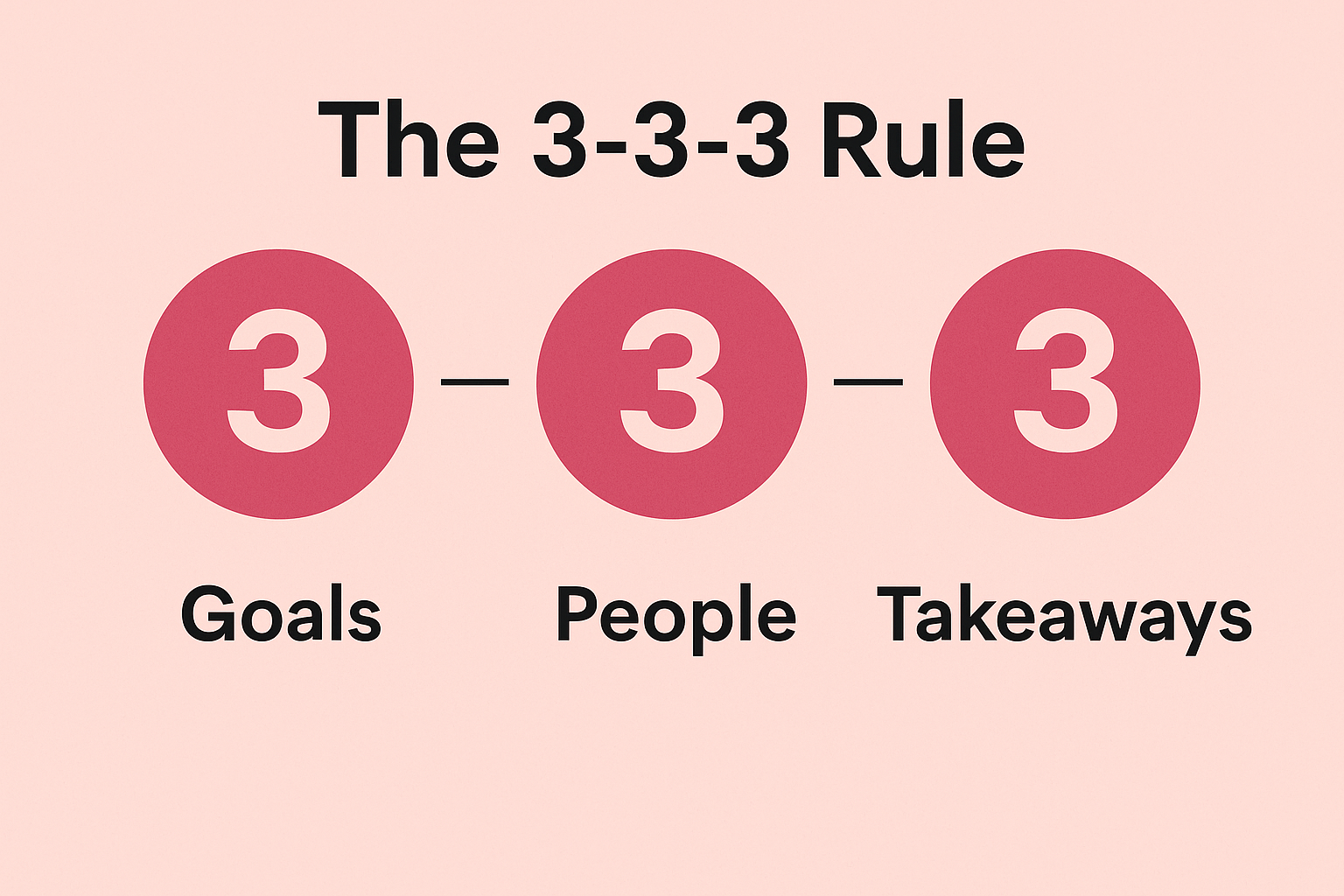
To avoid overwhelm and guarantee progress, set this intention:
- 3 Conversations: Three meaningful chats with your ideal profile
- 3 Commitments: Three agreed next steps with deadlines
- 3 Pieces of Content: Three useful shares (post, video, newsletter paragraph)
If you deliver the 3–3–3, you’ll reliably create value — regardless of event size or price.
Calculating Event ROI (Without Guesswork)
Move past vague impressions with a practical approach:
- Direct ROI (Commercial):
- Revenue from deals attributed to the event
- Lifetime value (LTV) of clients acquired
- Partnership deals with projected value
- Indirect ROI (Brand & Pipeline):
- Speaking and media opportunities confirmed
- Referrals initiated and partner intros received
- Email list growth, website traffic spikes, social engagement
- Cost of Attendance (Total):
- Ticket price + travel + time cost (your day rate)
- Prep and follow-up hours
- Time-to-Value:
- How quickly the first result landed (eg booked call within 48 hours)
When you track both direct and indirect ROI, you’ll start to see why some “low-cost” rooms are gold mines and some “premium” ones underperform — it’s about fit and follow-through.
Common Myths to Drop
- “If it’s pricey, it must be good.” Price signals positioning, not guaranteed outcomes.
- “I’ll see what happens.” Intentionality beats passivity every time.
- “Networking is selling.” The best connectors serve first, then sell.
- “I didn’t meet any clients.” Partners, referrers, and media can be worth more than a single sale.
Make Every Event Count: A 10-Point Checklist
- Clear objective and two secondary goals
- Target attendee list and pre-event messages sent
- Value hook and proof point rehearsed
- CTA, booking link, and resource ready
- Questions prepared for speakers and panels
- Notes captured with context and next steps
- 48-hour follow-up emails scheduled
- Three pieces of content published within a week
- Outcomes logged in CRM and reviewed after 30 days
- Decision: repeat, refine, or replace this event next time
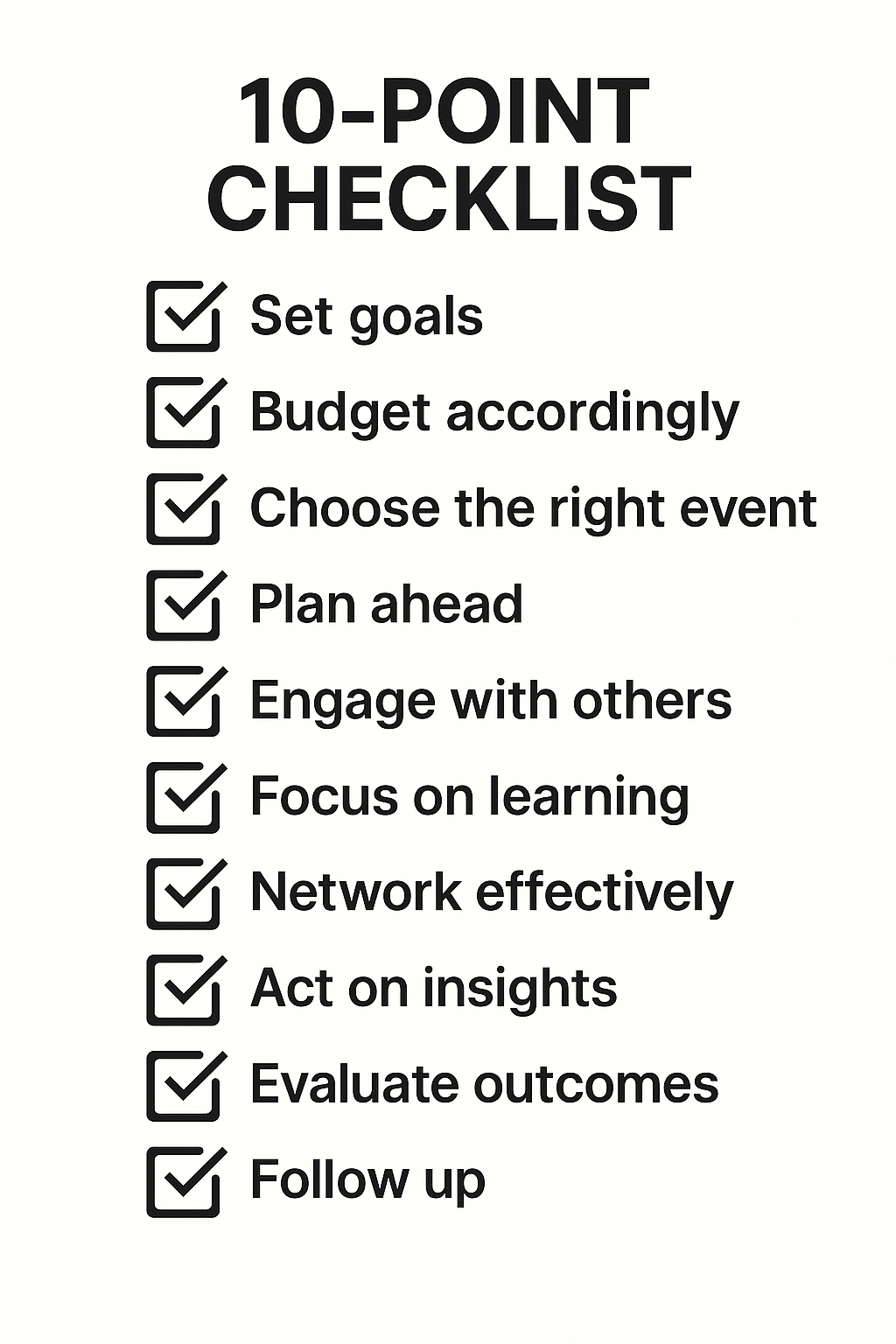
Value Is a Verb
The true value of an event doesn’t reside in the ticket line. It lives in your preparation, participation, and persistence. When you show up with purpose, contribute generously, and follow through decisively, events stop being “expenses” and start becoming multipliers — of ideas, influence, and income.
AND – Remember Business Cards and/or flyers.